I signed up for ChatGPT Ads so you don't have to

Everyone is posting that OpenAI launched ads. Almost nobody is telling you the one setting that decides whether it is worth a single euro of your money. So I clicked through every screen.
Ads inside ChatGPT went from “apply and wait” to “start now” this month. General availability. So instead of reading someone else’s hot take, I opened the panel, created a real advertiser account, and went through it screen by screen. It took twenty minutes. Here is what is actually inside, and the part that matters more than all the rest of it combined.
The first screen already told me something
Before you touch a single campaign, ChatGPT Ads asks you to confirm your account details. Country, currency, timezone, and then a quiet little question: is your business an agency?
I said yes, because I run one. And it stopped me.
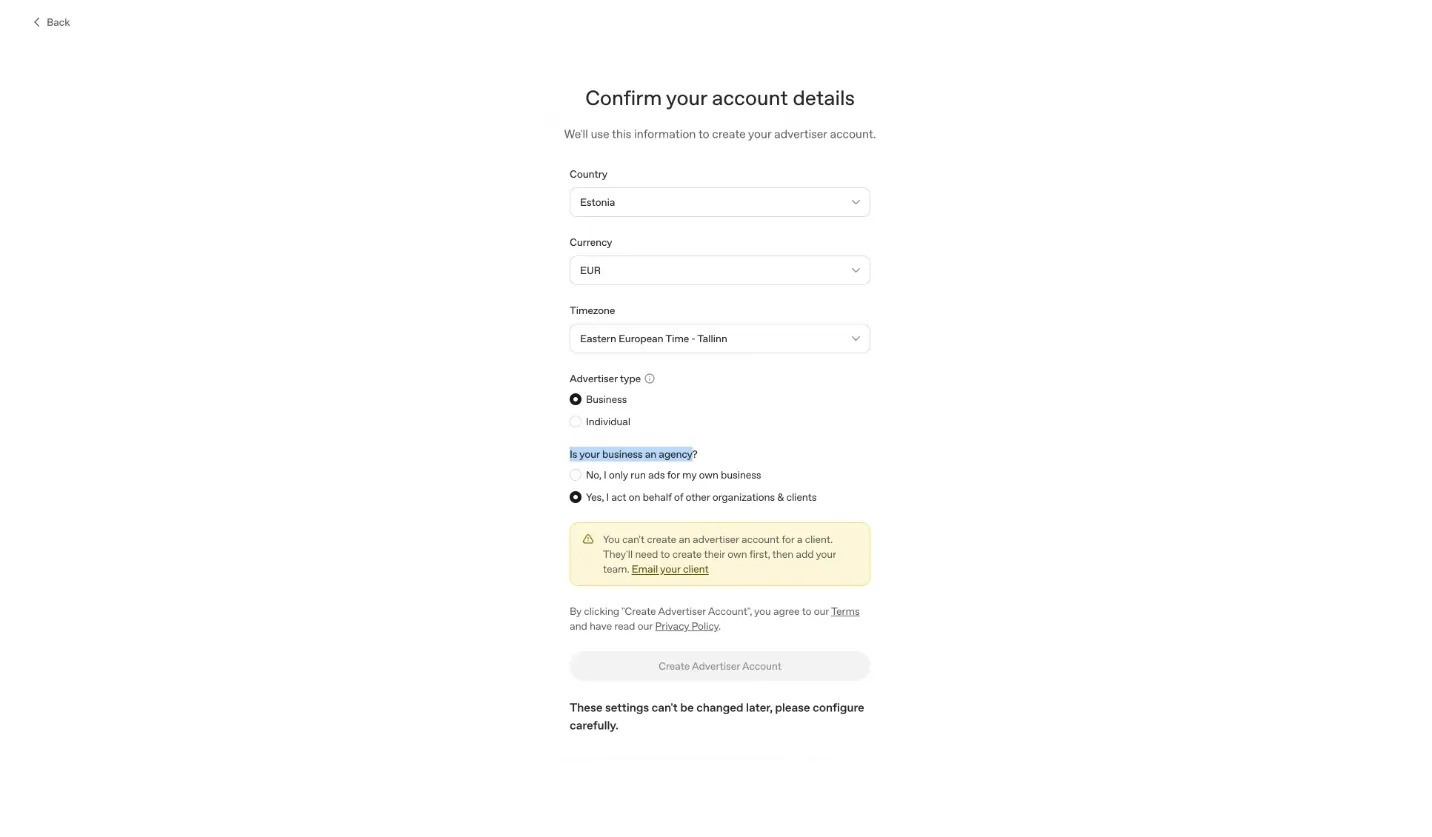 “You can’t create an advertiser account for a client. They’ll need to create their own first, then add your team.”
Read that again if you run ads for other people. The old agency model, where you spin up an account on behalf of a client and manage it from your side, does not exist here. The client creates their own account, then invites your team in. It also warns you that these settings cannot be changed later. So if you are an agency, your first job is not building a campaign. It is emailing your client.
Where it works, and where it does not
Next surprise, and it is a big one if you are reading this from Europe. ChatGPT Ads is live in seven countries.
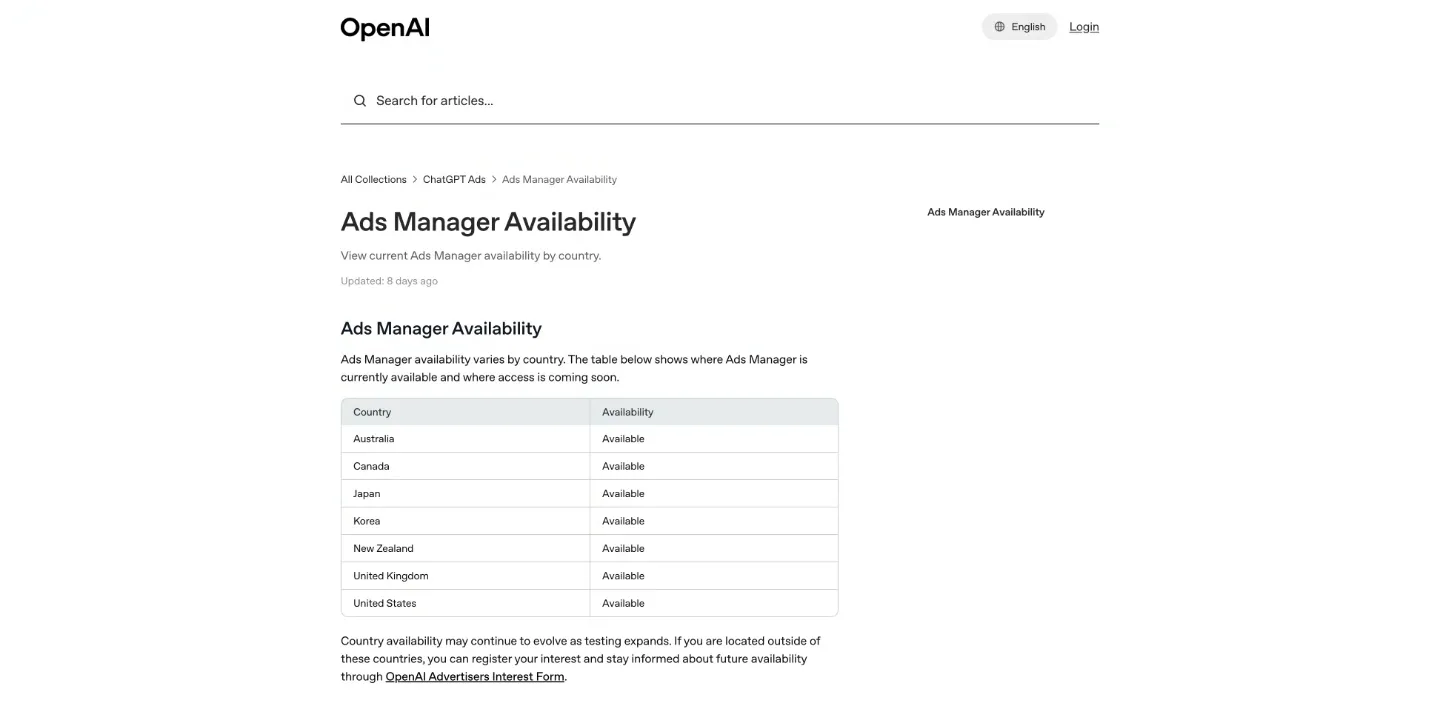 Australia, Canada, Japan, Korea, New Zealand, the United Kingdom, the United States. Per help.openai.com, updated this month.
No Finland. No Estonia. No EU at all. That is not an accident and it is not an oversight. The whole thing runs on context targeting, which means it reads what the user is talking about, and a system that knows that much about a person is exactly the kind of thing that does not get waved through in Europe on day one. So for now, if your customers are here, this is a thing to understand, not a thing to buy.
I picked the United States to see the rest of the panel.
The campaign itself is boring, in a good way
If you have ever touched Google Ads, none of this will scare you. You name the campaign, pick an objective, set where and how much.
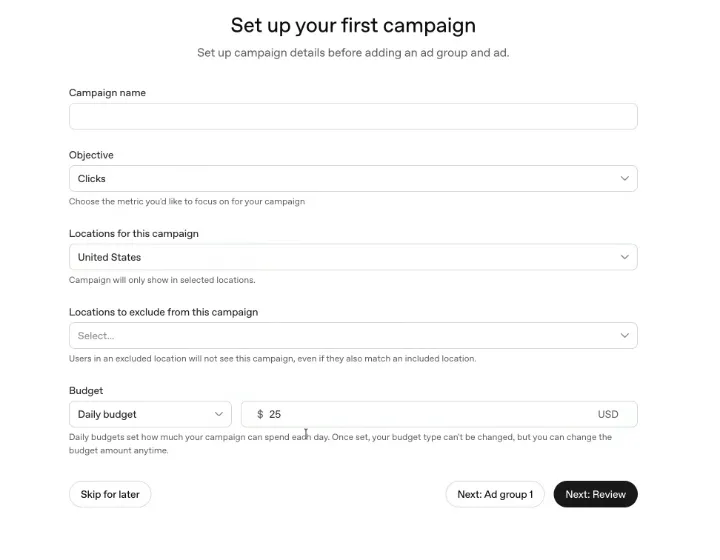 Objective, locations, and budget. The minimum daily budget is 25$.
Two objectives right now: clicks and reach. Conversions are “coming.” I do not care about reach. Reach is impressions, and impressions do not pay rent. Most advertisers want clicks, and what they actually want underneath that is conversions, which is not here yet. So today you are buying clicks, with a minimum of 25$ a day.
Locations can be one country, several, or every supported country at once, and you can exclude locations too.
The bidding tells you when you are being cheap
You set a maximum cost per click, and the panel grades you live. Minimum bid is one cent. Maximum is 100$.
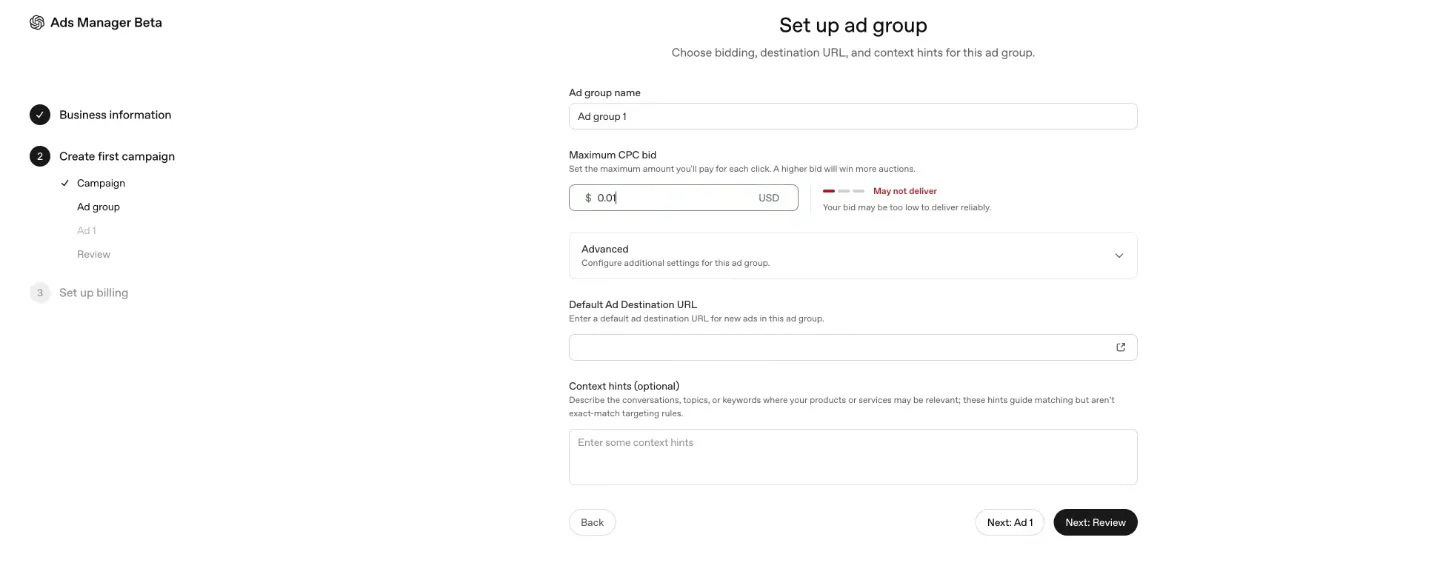 0,01$ gets you a red “May not deliver.” Push it to a few dollars and it flips to green “Strong Delivery.”
I put in one cent and it told me, politely, that my ad would basically never run. A dollar, same story. Around three to four dollars it went green. Useful, because it means you are not flying blind on what a click costs in this auction. It depends on your targeting and competition like everywhere else, but the panel at least tells you when you are lowballing it.
Audiences, and an honest word about the “hashed” part
You can upload your own customer list to build an audience. Emails or phone numbers, as a CSV or TXT file, up to 500 MB, which is millions of people if you have them.
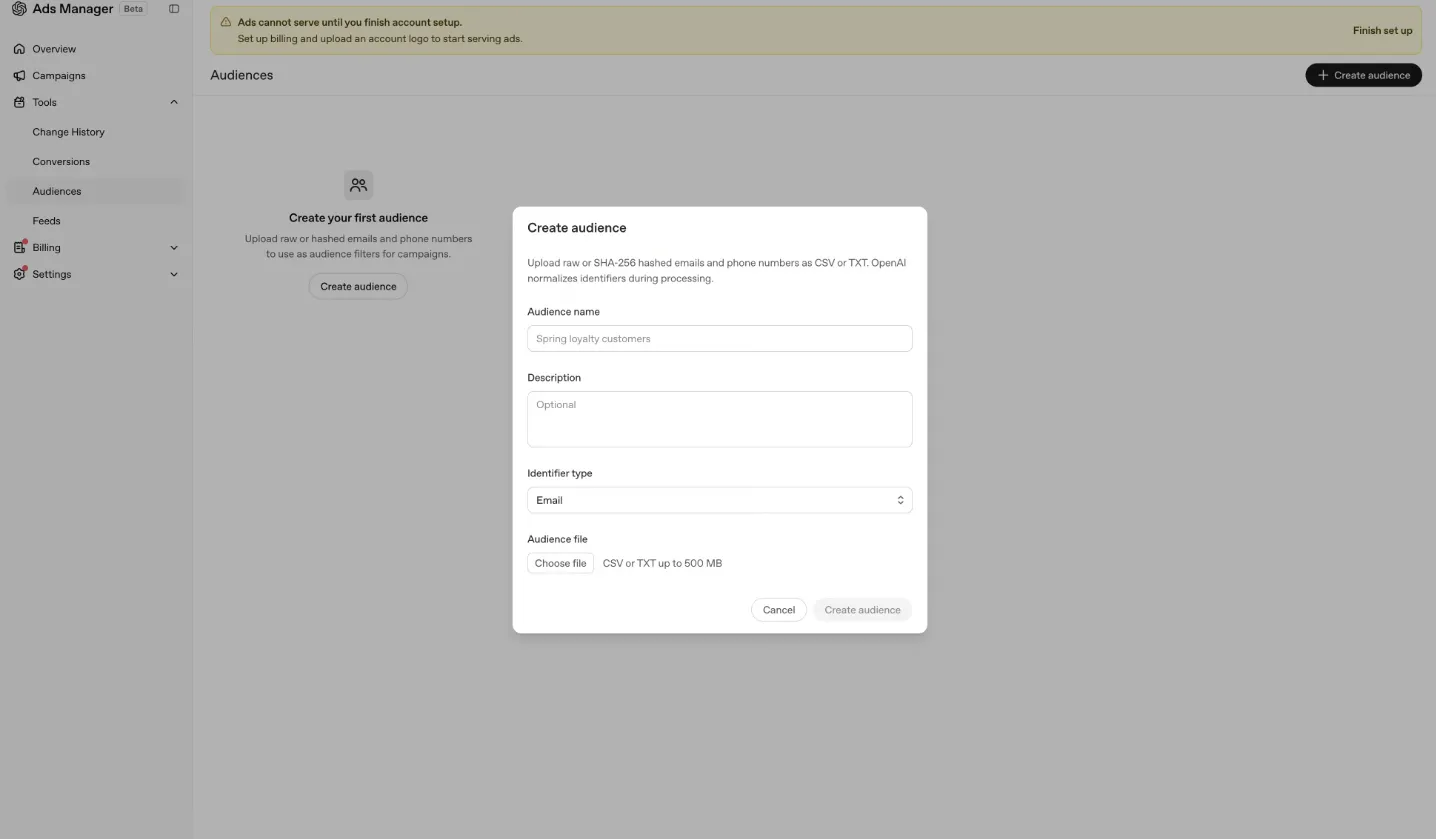 Raw or SHA-256 hashed, up to 500 MB.
Here is where I want to be precise, because the loose version of this claim is wrong. You can upload the list hashed with SHA-256 instead of as raw emails. Hashing is a one way process: it turns an email into a fingerprint that OpenAI can match against its own users without you handing over the plain address. That is a real improvement over pasting raw emails into someone else’s box.
But do not oversell it to yourself. A hashed email is still personal data. OpenAI still matches those fingerprints against real people, and the panel says as much: it “normalizes identifiers during processing.” So this is “I did not hand over the raw list,” not “no data changed hands.” And, again, none of this is live in the EU yet, so for a European business it is theory for now, not practice.
There is also a bid multiplier for audiences. Bid lower on people who are already your customers, higher on a list of people you want. That part is genuinely nice.
Targeting is a paragraph, not a keyword list
This is the part that feels new. There is no keyword list. You describe your product in plain language and the model decides where it fits.
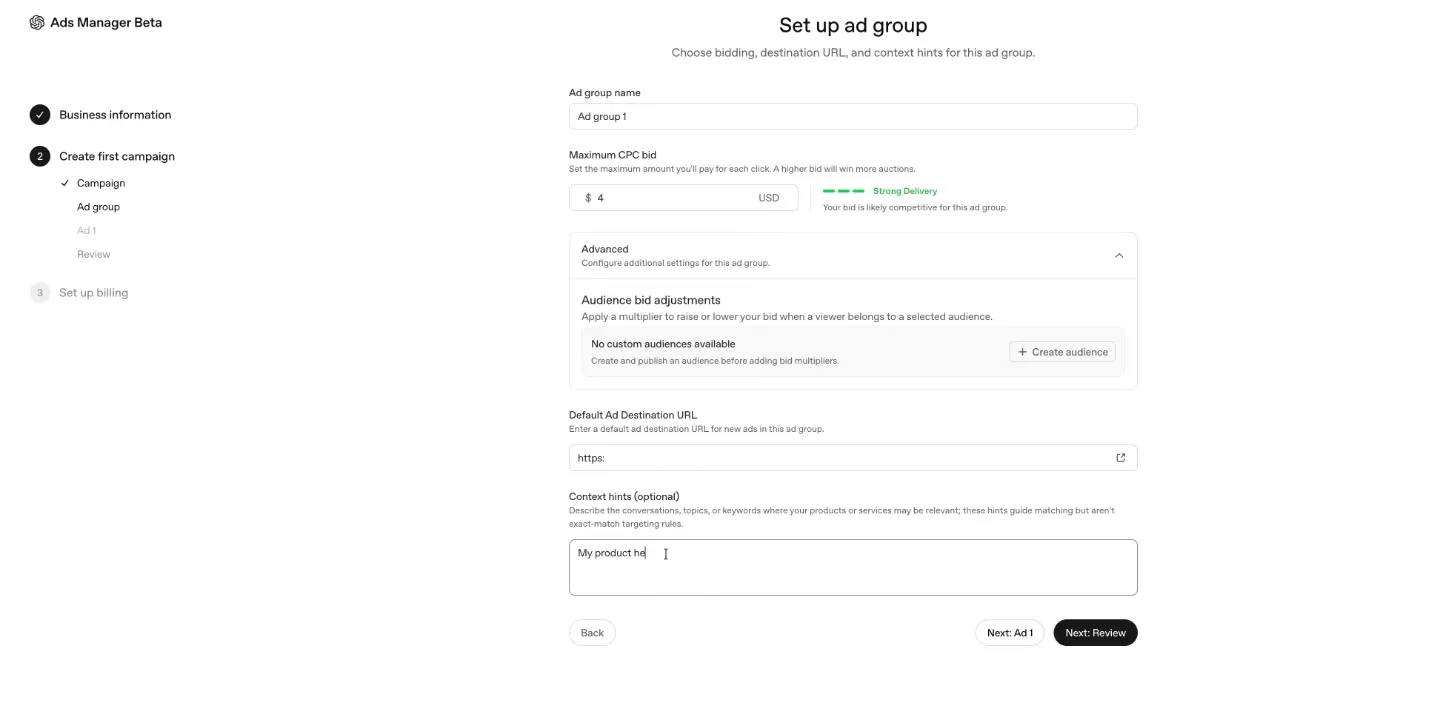 “Describe the conversations, topics, or keywords where your products or services may be relevant. These hints guide matching but aren’t exact-match targeting rules.”
So instead of bidding on “company data Finland,” you write a sentence: my product helps companies get business information about companies in Finland, we are Finland’s largest business data provider. You give it context, and the AI does the matching. If you have run Google Ads for years, this will feel either liberating or terrifying, depending on how much you like control. It is a genuinely different way to target.
Feeds work the same way for shops: connect a product feed over SFTP and your catalogue stays in sync. Conversions can be tracked with a pixel and Google Tag Manager, roughly like Analytics, though you cannot optimise toward conversions yet, only measure them.
The ad itself
Standard stuff. Destination URL, a headline up to 50 characters, a description up to 100, a square image at least 256 by 256 pixels, and a live preview. Multiple ads per ad group.
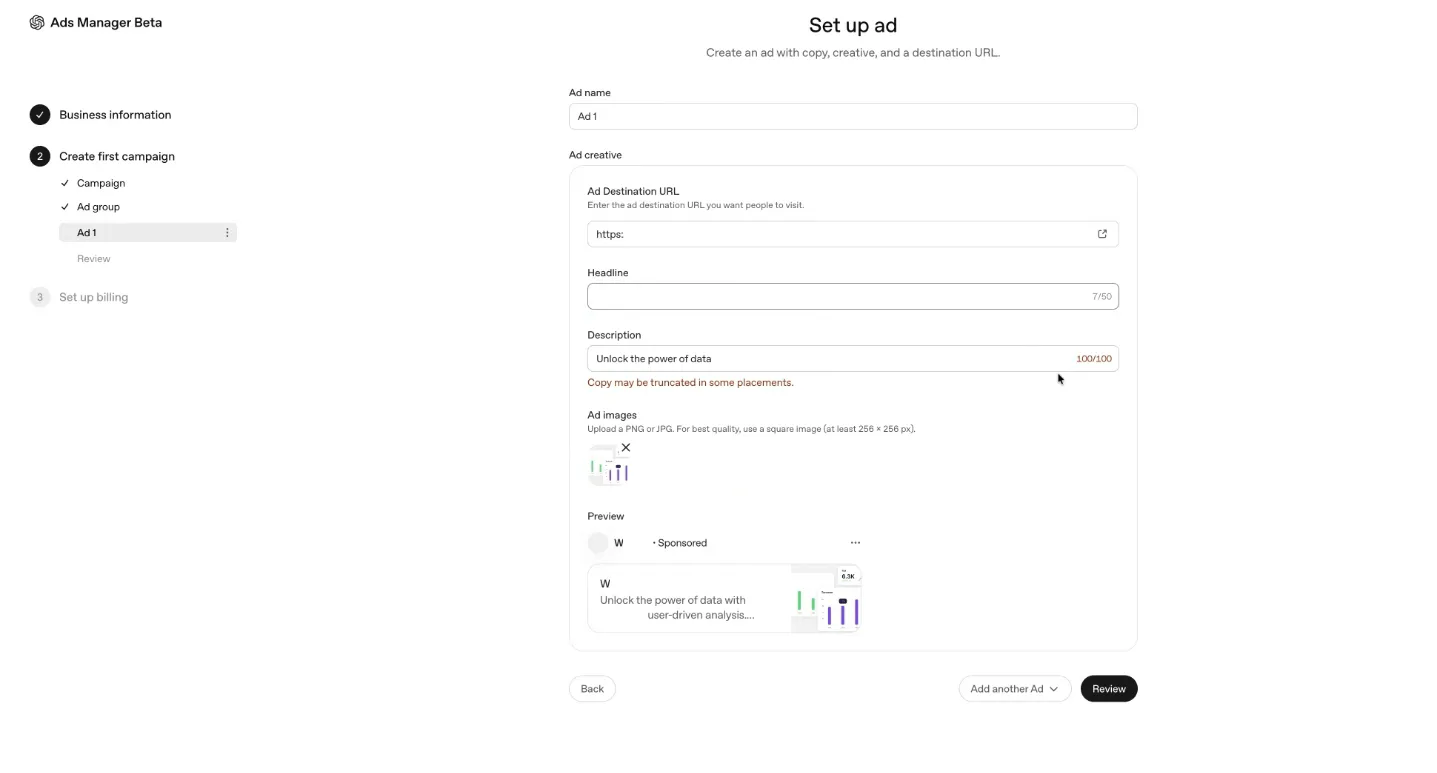 Headline 50 characters, description 100, square image. It warned me the copy might get truncated in some placements.
Nothing surprising. It refused my SVG, which is fair.
Now the one setting that changes everything
Everything above is table stakes. This is the part almost nobody is posting about, and it is the only thing that decides whether ChatGPT Ads is worth your time.
Who actually sees these ads?
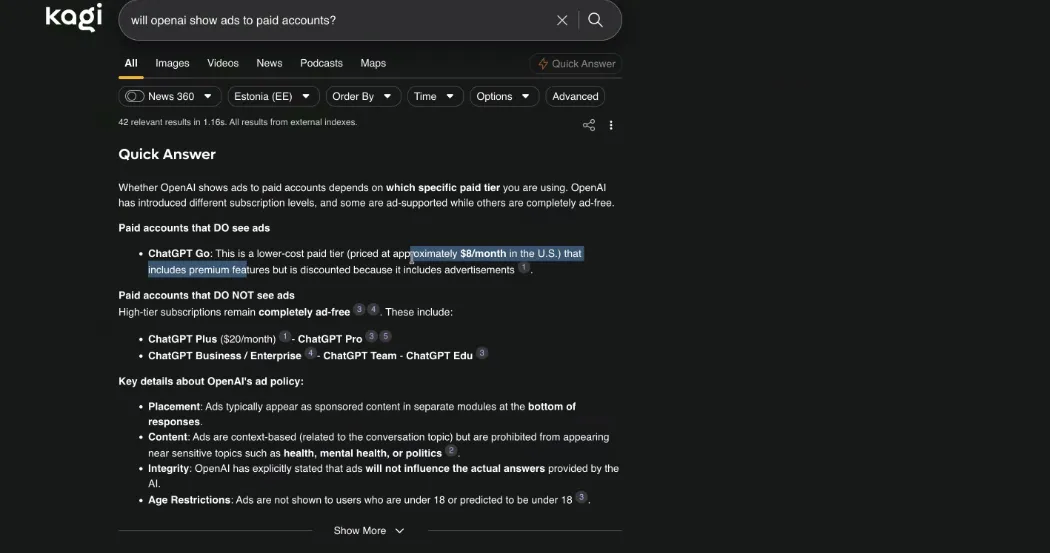 I looked it up rather than guessing. The answer traces back to OpenAI’s own help page: ads may appear for Free and ChatGPT Go users, while Plus, Pro, Business, Enterprise, Team and Edu do not see them. (And yes, that is a paid search engine. Its own post is coming.)
Free users see ads. ChatGPT Go, the subsidised 8$ tier, sees ads, which is the honest deal there: you pay 8$ and you still get advertised to. And that is it. Plus at 20$, Pro, Business, Enterprise, Team, Education: no ads at all.
Sit with what that means. You are not reaching the person who pays 20$ or 200$ a month for AI at work. You are reaching the person who will not pay for it. So if your customer is a business, a professional, anyone with a budget, they are on a paid plan and they will never see your ad. This is a consumer channel wearing an enterprise haircut.
Two more things worth knowing: the ads sit at the bottom of the response, they are context based but blocked from sensitive topics like health, mental health and politics, and they are not shown to anyone under 18. OpenAI also says the ads do not influence the actual answers. Fine. But the plan-tier point is the one that should decide your budget.
So who should actually run this?
I want to be fair about what this is, because “only reaches non-payers” sounds like an insult and it is not.
It is a B2C channel. If you sell to normal consumers, this is interesting. Online shops, especially: upload your product feed, target the parent searching for a trampoline for their kid, and you are in front of exactly the right person. Students are another obvious one, because students live on free accounts. If your audience overlaps with people who do not pay for ChatGPT, this could be very good for you.
If you sell to businesses, save your money.
And here is my actual take. If you are in one of the seven countries, you are B2C, and your category fits, I would spend 300 to 500$ to test it right now. Not because I am sure it works. Because it is early. Google Ads is a knife fight. Meta is a knife fight. This is not, yet. Early on a new channel you get cheap clicks and cheap visibility, and the moment everyone wakes up and piles in, the prices go up and that window closes. I have watched it happen on every ad platform before this one.
For a European business, none of that applies today. So the useful thing here is not a campaign. It is knowing exactly what this is, and what it is not, before the noise tells you otherwise.
It is an ad platform that only reaches the people who would not pay to get rid of ads. Know that before you spend a cent, and you already understand it better than most of the people posting about it.