I have quit Notion three times. Now I am setting a company up on it.
I have abandoned Notion three times. Last week I set an entire company up on it. What changed my mind is not the feature list - it is that Notion stopped building for people like me and started building for companies.
I have tried most of them. Evernote, back when Evernote was good and before everybody left. Amplenote. Capacities, where everything is an object, which cost me a very enjoyable two weeks. Anytype. And Notion, three separate times.
The pattern was always the same, and it was never the tool’s fault.
The setup phase is the drug
What I actually enjoy is the setting up. I once built a system with 400 databases, relations running between all of them, automations wired through the middle. It took weeks. It was beautiful. And the moment it was finished, the moment the only thing left to do was actually use it, I was bored. On to the next one.
Then, about a year later, I would come back to a tool I had already abandoned and think: maybe now. Maybe it is better now. Maybe this time I will use it. That is how you get to three separate attempts at the same product.
Then AI arrived and made it much worse. I vibe-coded my own knowledge management system, from scratch, exactly the way I wanted it. That turns out to be the single most dangerous thing an ADHD person can do, because the setup phase now has no end. Before, I could spend two weeks on databases and automations and eventually run out of things to configure. With AI there is no done. You want it to run a local model? Fine. You want everything indexed with vectors? Also fine. It is a partner that says yes to every idea you have ever had, forever.
So when I tell you Notion finally stuck, understand that the bar it had to clear was not “impressive”. It was “finishable”.
Why I came back anyway
This time it was not for me. I have a client with no real documentation or knowledge management system, and that needed fixing.
My own instinct is always the same one: self-hosted, private, nothing in somebody else’s cloud. But I had to be a realist about who was going to open this thing every morning. Non-technical people who live in Google Calendar and Google Drive, and developers who would need it to go considerably deeper than that. It had to be immediately obvious to the first group without being useless to the second. And it had to scale.
So for the first time in years I set Notion up properly. Notion, it turns out, has not been sleeping.
One disclaimer before I start being nice about it: I do not use Notion personally. I use it with a client, and for them it is the right call. My own system is still the one I built myself, which is a story for another post.
There is no money in personal notes
Before the features, the strategy, because I think the strategy is the actually interesting part.
The personal knowledge management space is unbelievably crowded. Everyone has built one. I have built one. What that space does not have is money. Companies in it go quietly bankrupt, and in my experience only two shapes survive.
The first is two people in a garage, where 300 or 400 paying customers covers everything. The burn rate is so low that it can run more or less forever, on passion, and the product is often genuinely good. Anytype is a real example of this: offline-first, completely private, syncing peer to peer without touching the internet. There is real innovation happening down there.
The second shape is to stop selling to individuals and go where the money is. That is business. Notion became famous with individuals - it made knowledge management popular, it made it sexy, it spawned an entire cottage industry of templates and Notion consultants - and then it took that reputation and pointed it at companies.
I think they did a genuinely good job of it. The rest of this post is why.
AI that does the work, not AI that proofreads
Every product on earth now has AI in it, and almost all of it is the same two features: find things, and rewrite the paragraph you are looking at. Summarize. Proofread. When Notion announced Notion AI and agents, I assumed it was that, with a name change.
It is not. What they built is AI that performs tasks, and the value is not the AI, it is what you can get done in Notion because of it.
Here is the thing I asked it to do, and I want to stress how lazily I phrased it.
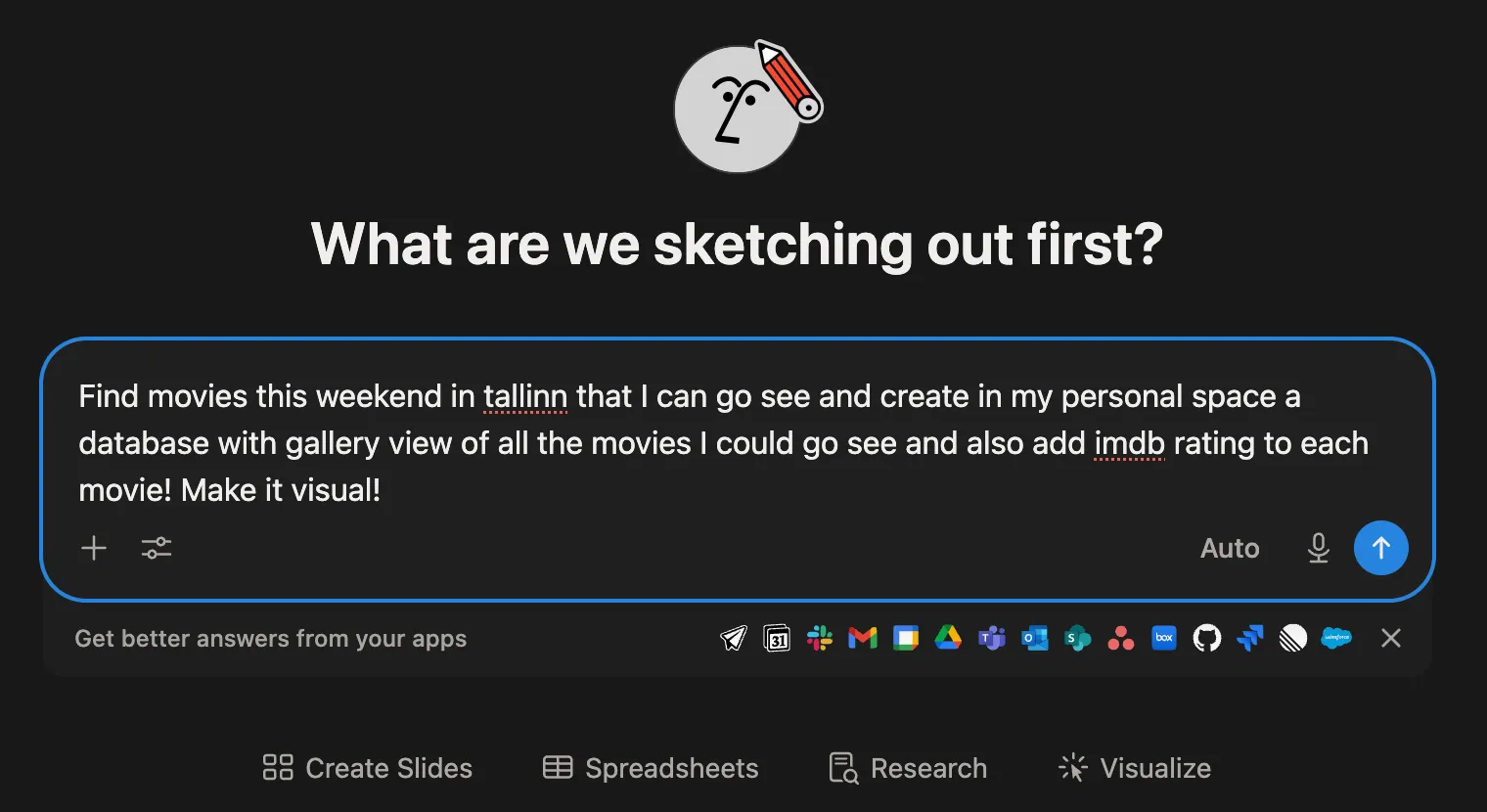 One prompt, typed badly on purpose: find weekend films in Tallinn, build a database with a gallery view, add IMDb ratings, make it visual.
That looks trivial. It is not. To do it, the thing has to crawl the web, parse and interpret what it finds, invent a database schema that makes sense for the answer, create the database, normalize the data, and fill it in.
Before it started, one detail I did not expect to care about as much as I did.
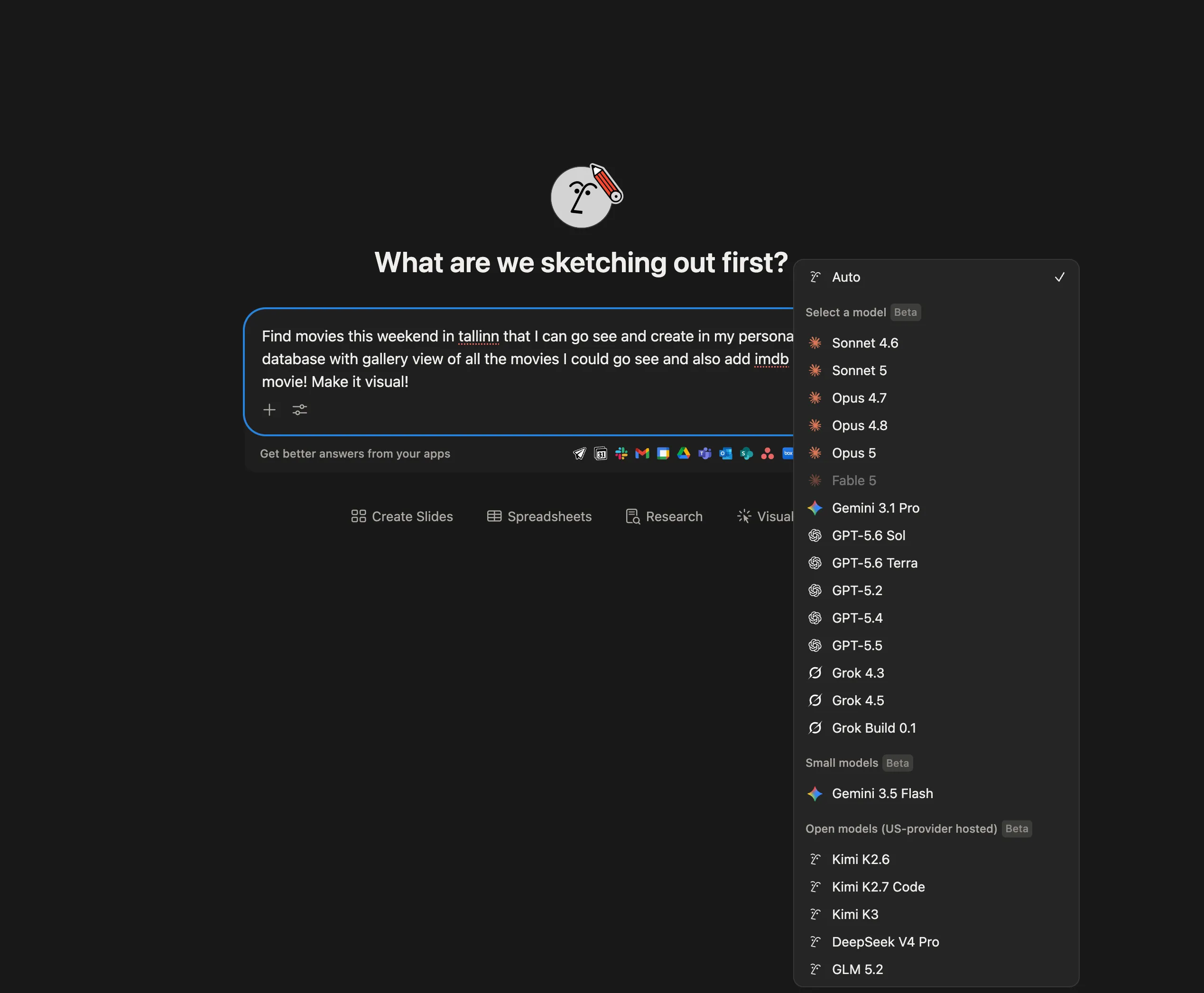 You pick the model. Sonnet, Opus, GPT-5.6, Gemini, Grok - and a section labelled “Open models (US-provider hosted)” with Kimi K3, DeepSeek V4 Pro and GLM 5.2 in it.
I wrote a while ago that open-source AI is turning into a commodity, and I am not going to re-argue that here. But seeing GLM 5.2 sitting in a picker inside an enterprise SaaS product, next to Opus and GPT, is that argument arriving somewhere I did not expect it. GLM 5.2 is my daily driver and has been for a month. Kimi K3 I still think is a little overhyped, and I will keep thinking that until I have run it properly myself.
The honest gap: I still cannot tell how much choosing an expensive model costs me. The relationship between model choice and credit burn is not explained anywhere I could find. I left it on Auto.
Then it went to work, using a research skill that Notion ships ready-made rather than making you build it, and crawled about 40 pages.
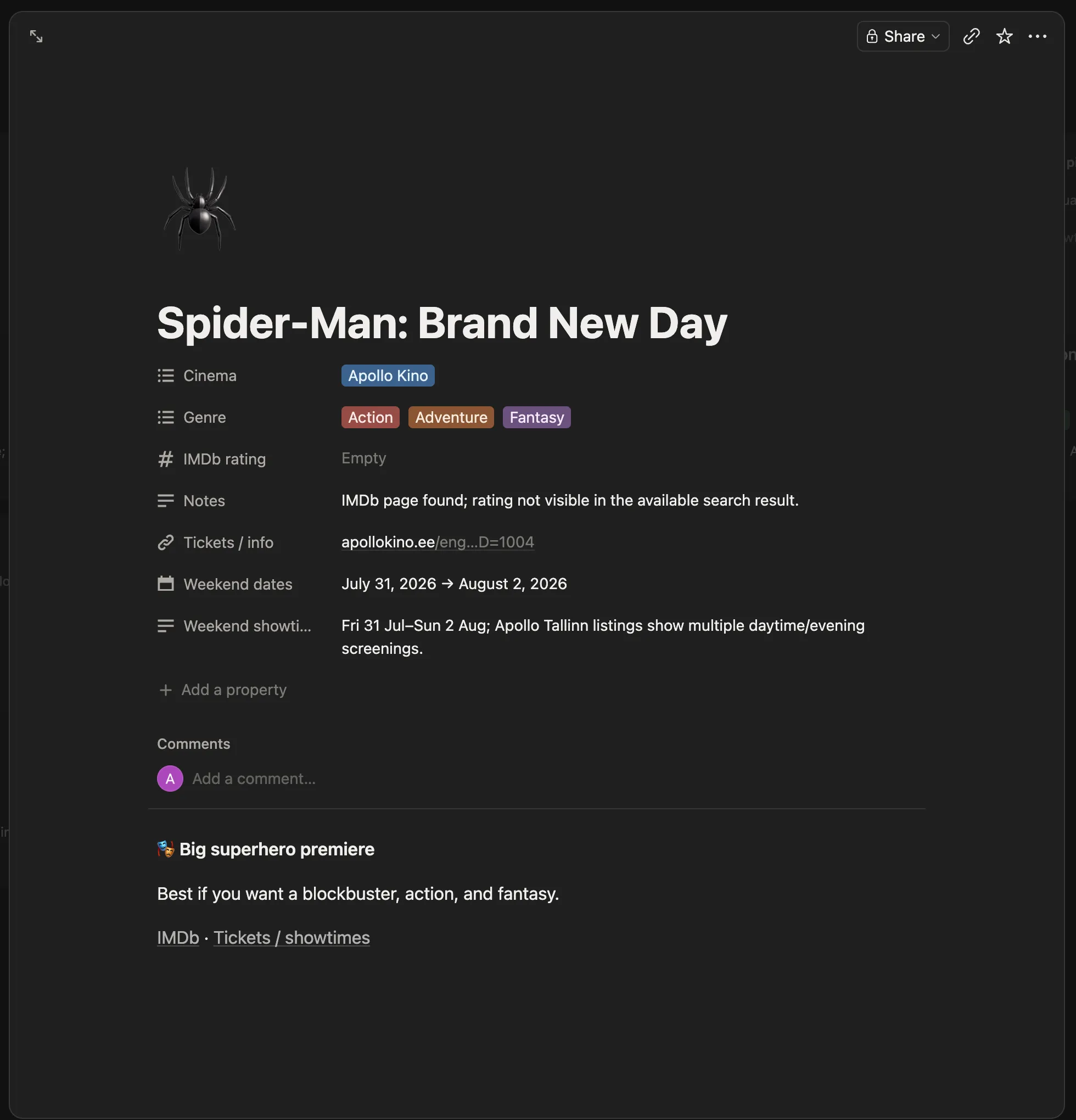 The record it built for one film. Cinema, genre, notes, a tickets link, weekend dates, weekend showtimes - none of which I specified.
Now the fair verdict, because there are two things it got wrong.
I asked it to make the result visual, and it did not - no posters, no images, just text. And IMDb does not allow easy crawling, so the ratings mostly failed: it got exactly one, a 6.7, and left the rest blank. You can see it being honest about that in the record above, where the note reads “IMDb page found; rating not visible in the available search result.”
What it did get right is the part I could not have specified in advance. Nobody told it that a film listing needs showtimes, a cinema, a genre and a ticket link. It worked that out. For one badly typed sentence, that is a genuinely good result.
We do not search for data, we search for answers
Here is a thing that is true of every company knowledge base and that nobody plans for: in a year or two, you will not be able to find anything in it from memory. There will be hundreds or thousands of pages, database rows, comments, files. Searching for the document is the easy problem. You do not want the document. You want the answer.
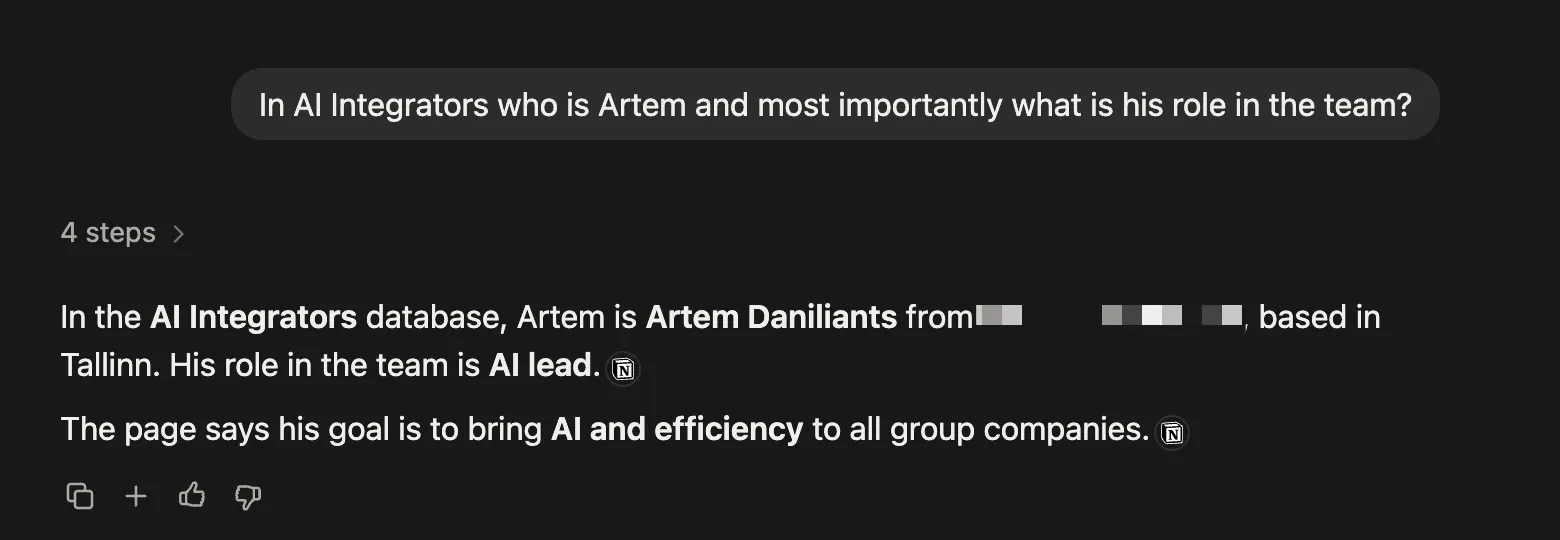 Asked about a person’s role inside the company workspace. It read the relevant pages and synthesized an answer, with the sources it used attached.
That looks simple and is not. It has to work out what the question is about, find the pieces that matter across the workspace, read them, and build one answer out of several documents. Same chat window also searches the public web, so it is the same box for both jobs.
Everybody gets a different AI
They also borrowed some good conventions from Anthropic and OpenAI, and I mean that as a compliment.
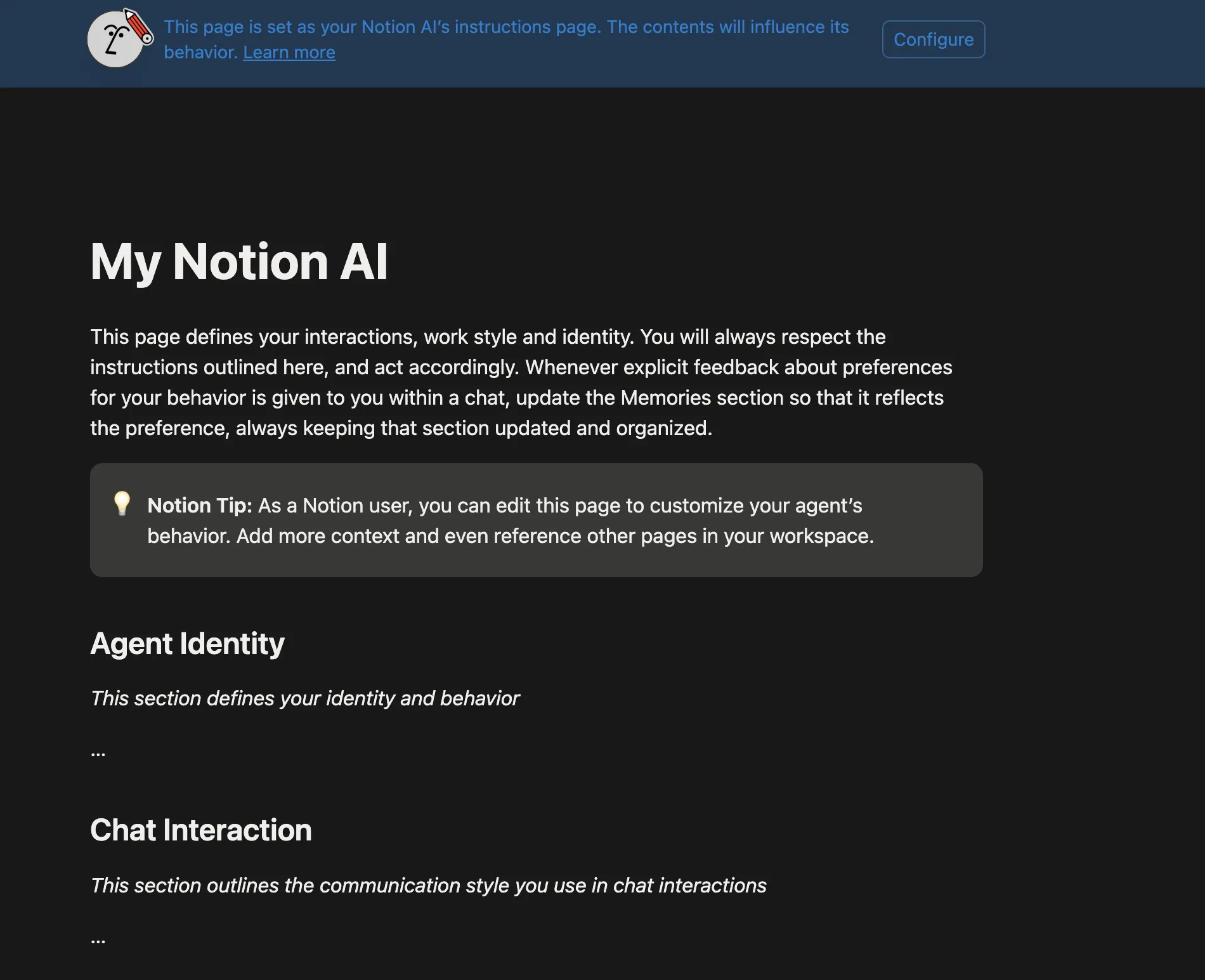 Your own instructions page: who you are, how the AI should behave with you, and how it should talk to you.
It is just a page. You write on it who you are, what you are trying to do, how you want to be spoken to. I could write on mine that I have ADHD, that I lose focus, that I say yes to people far too easily even when I am already at capacity - and it would take that into account. Below it, a memories section fills itself in over time.
The result is that the AI is different for every person in the company, which is the correct design. My assistant should not behave like the finance team’s assistant.
They decided to kill the meeting notes industry
There is an entire category of SaaS products that join your calls, transcribe them and email you a summary. Notion appears to have looked at that category and decided to simply absorb it.
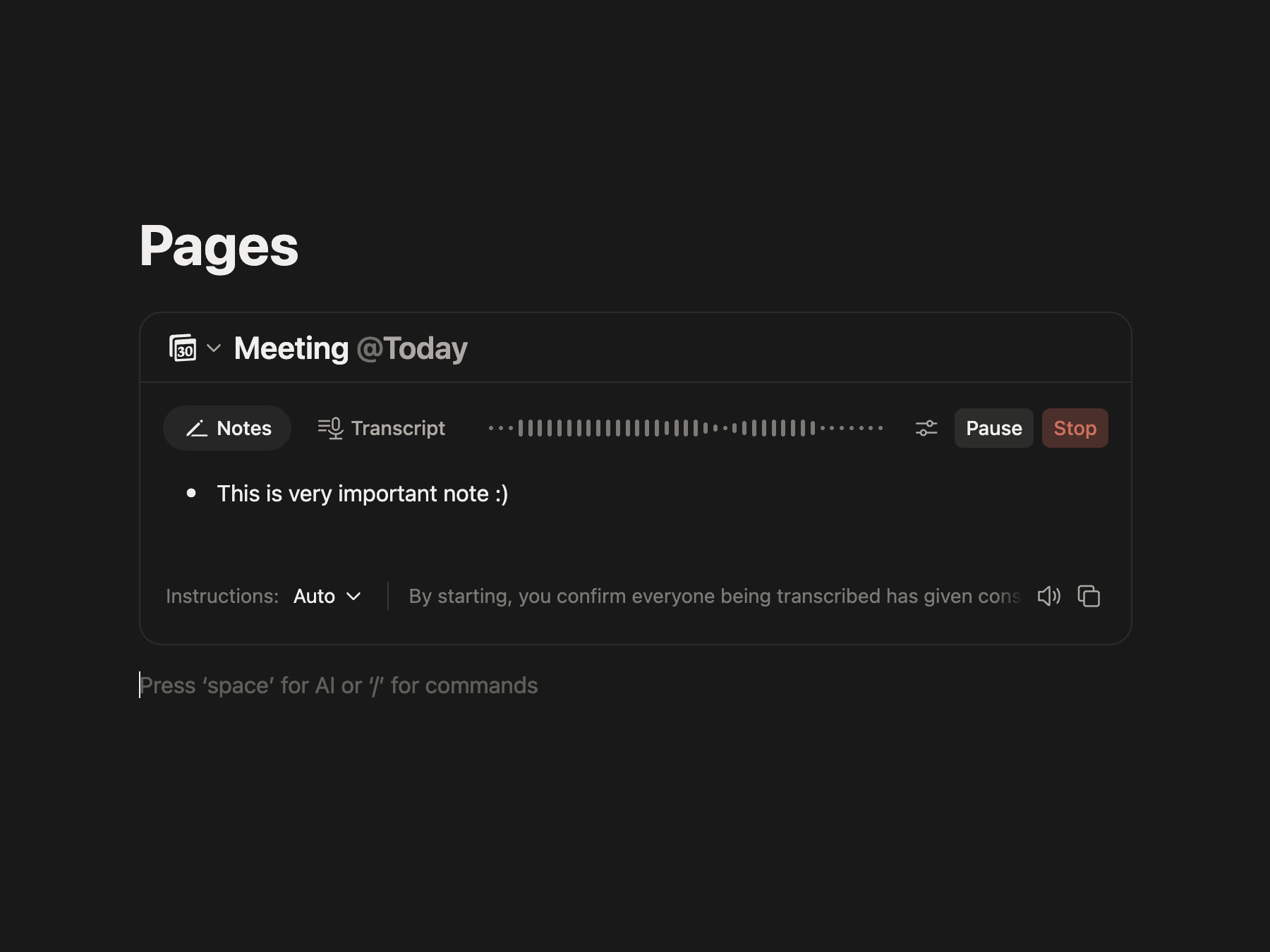
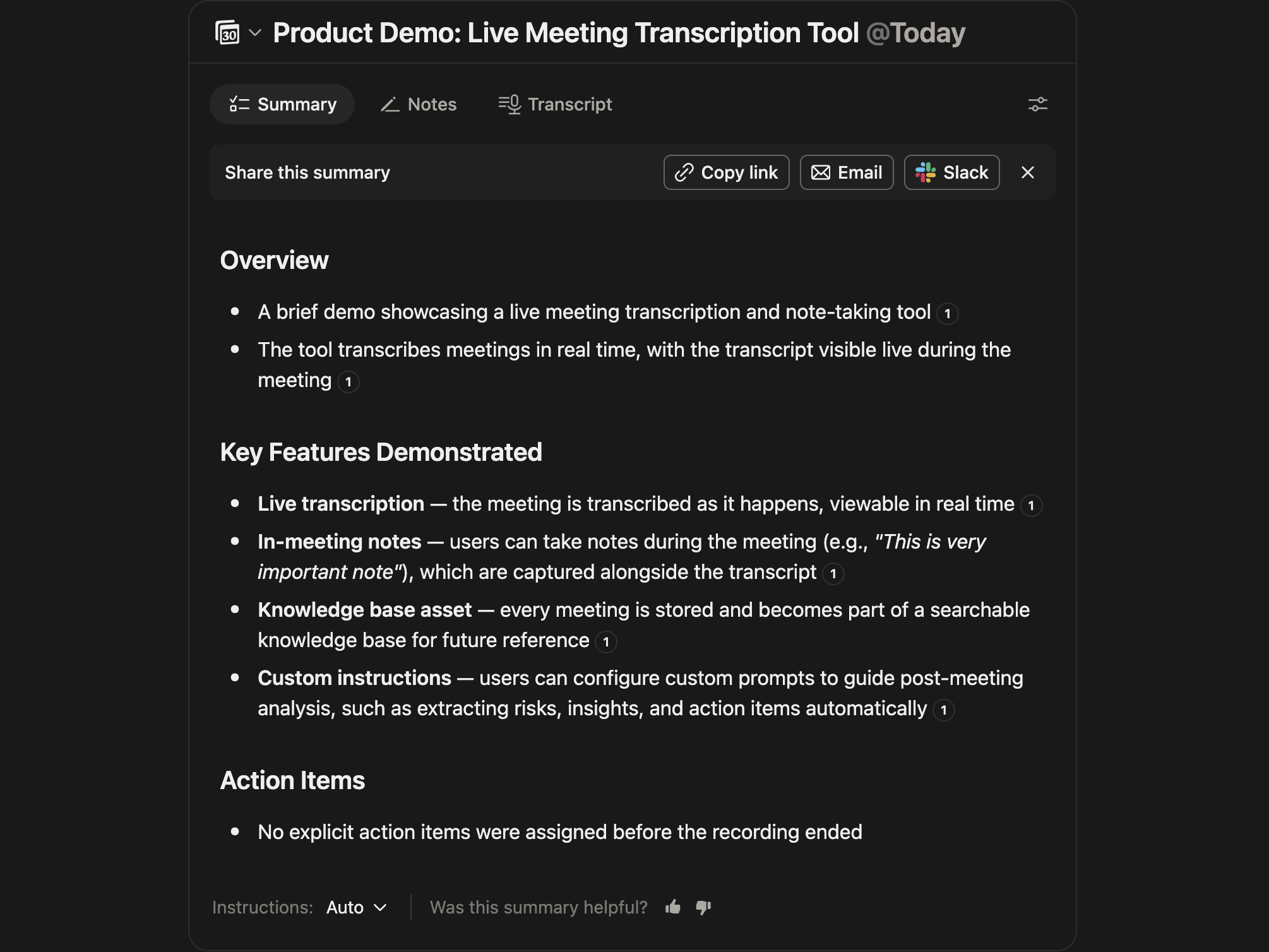
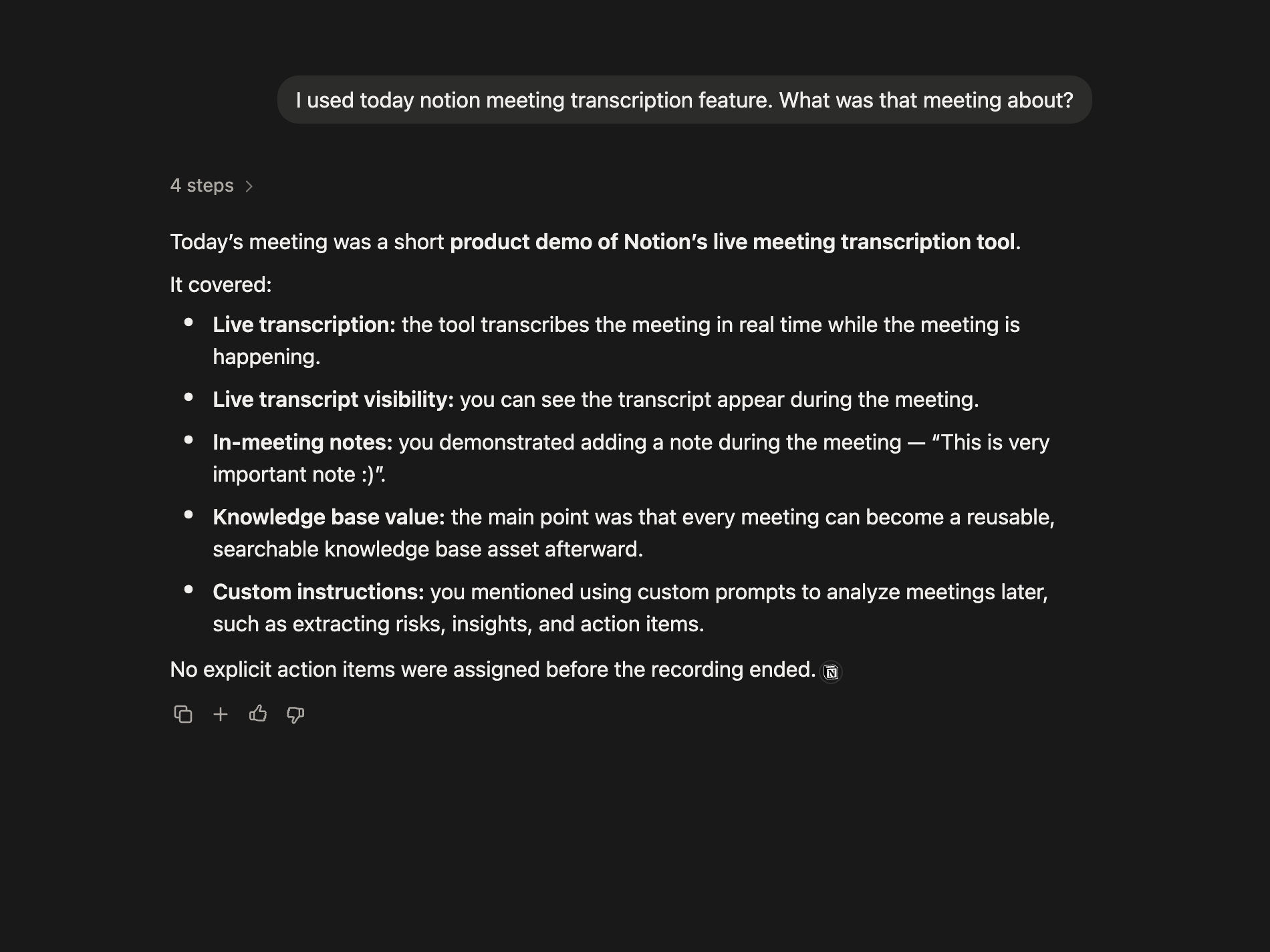
That last screenshot is the whole point. It is not that Notion can transcribe a meeting - lots of things transcribe meetings. It is that anything you put into Notion becomes queryable afterwards, without you doing anything to make it so. Every meeting turns into an asset instead of a file somebody has to remember to look at.
Agents for companies that will never build one
Then I found the agent builder, and this is the part where I think Notion has been genuinely clever.
None of what follows is technical innovation. I want to be clear about that, because I do not want to oversell it. There is nothing here you could not assemble yourself out of parts that already exist. What Notion did was polish it and make it usable by people who are never going to assemble anything.
Everybody in the enterprise world knows what agents are. Very few companies can actually produce one in five minutes.
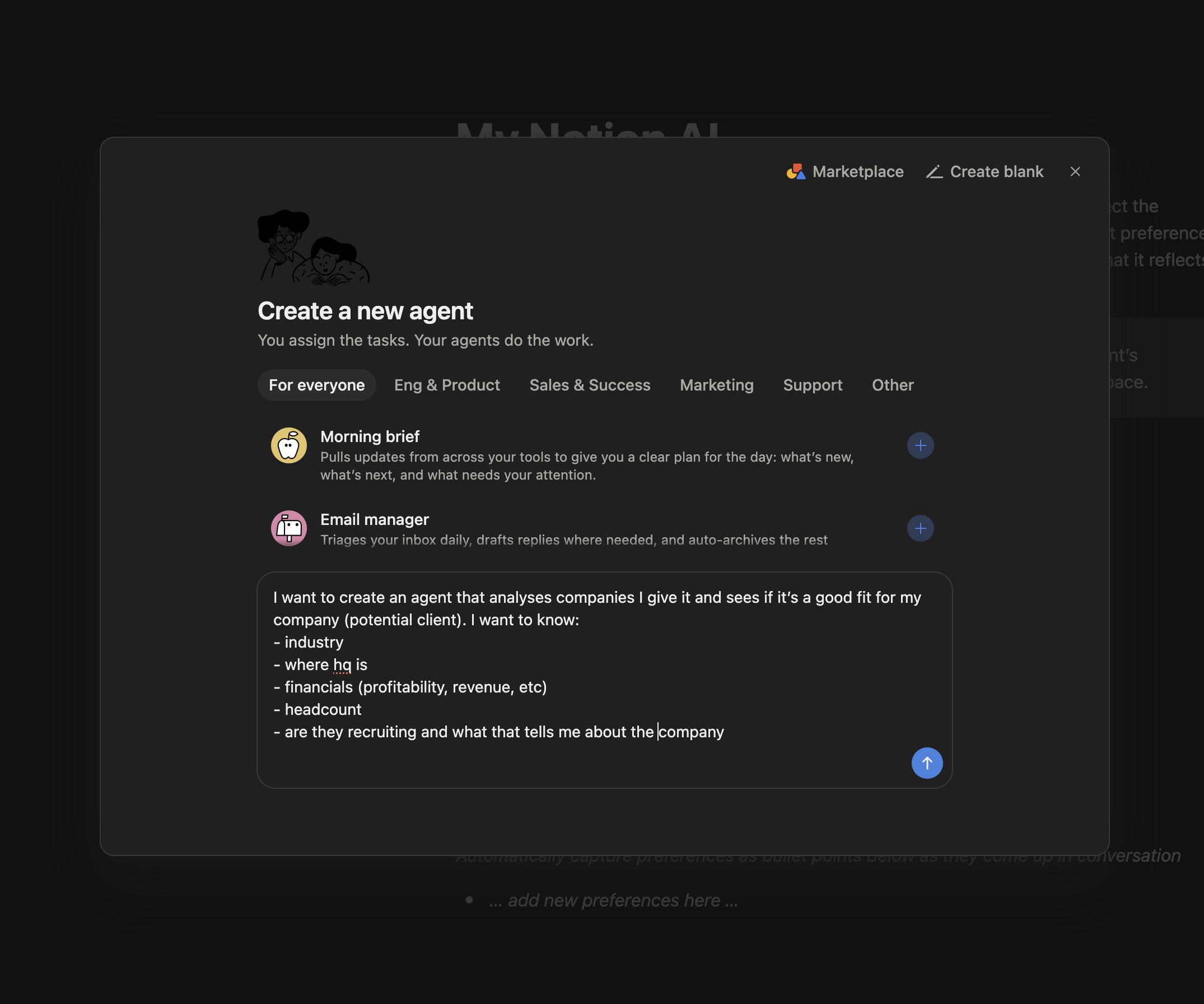
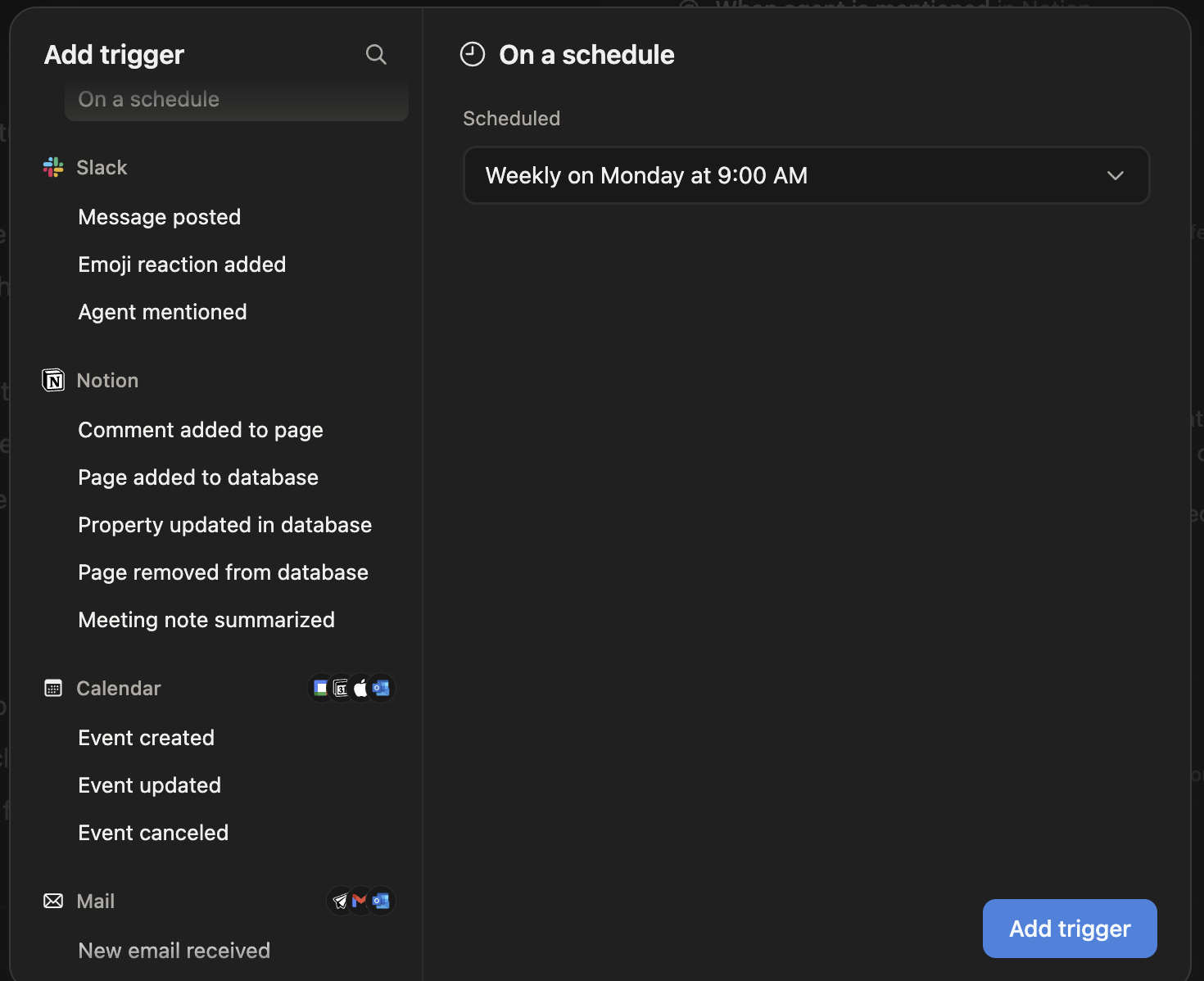
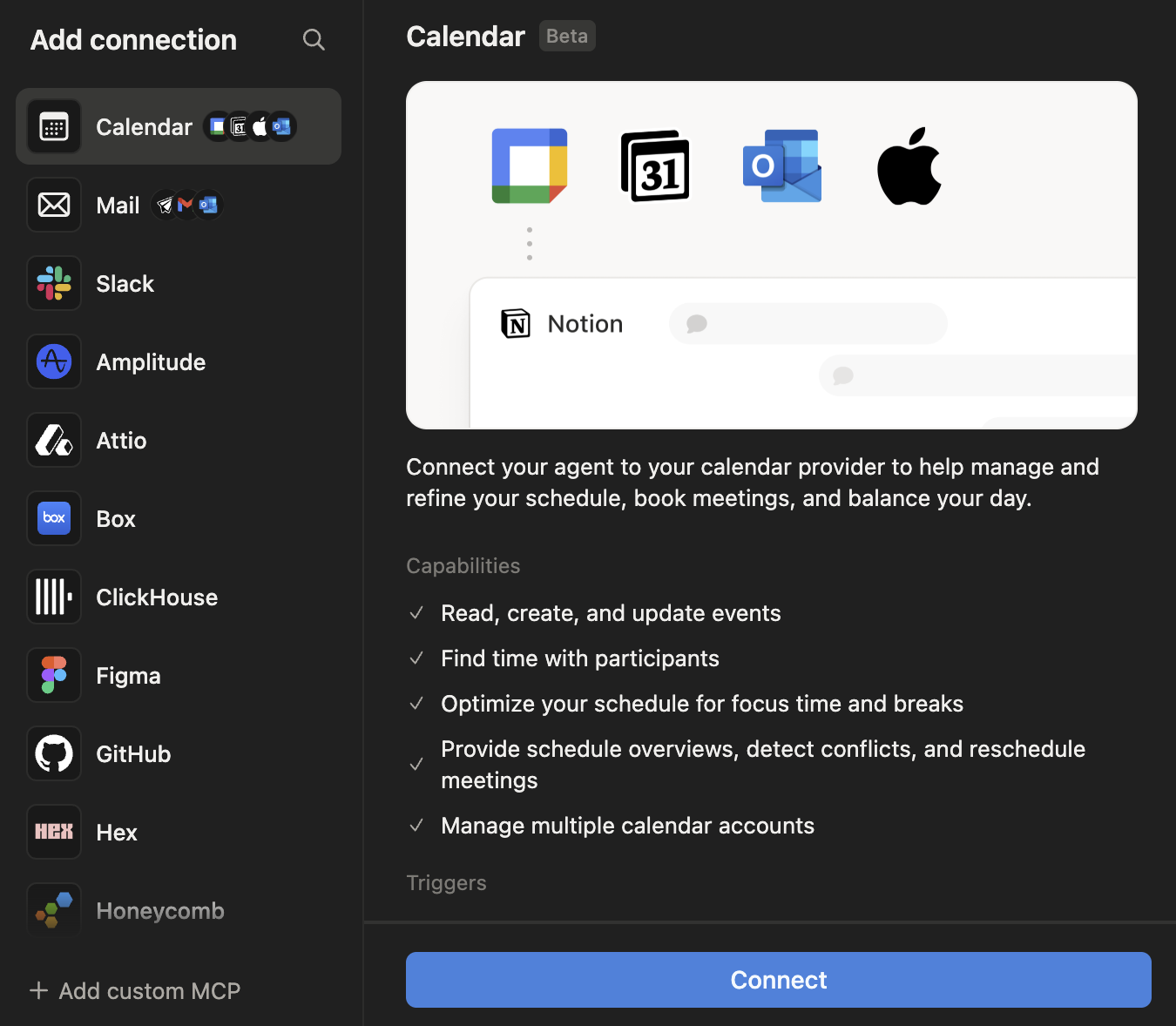
The Slack trigger is the one I keep thinking about. Connect it, and anybody on the team can ask for a piece of research in the channel they are already sitting in, and the answer comes back there. No new tool for anyone to learn. You can share an agent with the team or keep it to yourself, and you can define precisely what it may and may not reach.
One real complaint. Agents run on credits, and Notion has made credits hard to keep track of - you have to go digging in settings to find out where you stand. I do not think that is an accident. When a company commits to a tool and the tool is useful, the company pays for more credits. There is no commercial reason to put a burn-rate meter in front of you, so there is not one.
The part aimed squarely at enterprises
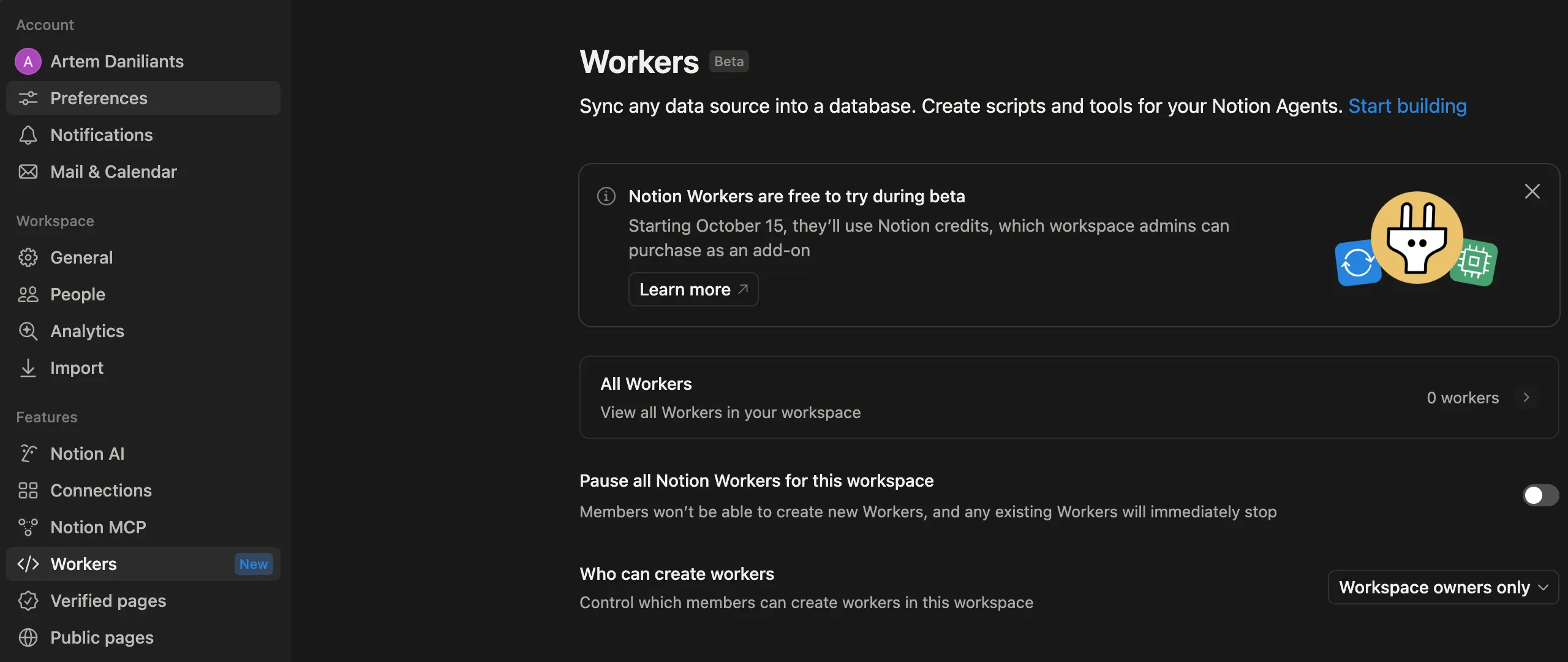 Workers: sync any data source into a Notion database. Free during the beta, and the notice on the page says it starts consuming credits on 15 October.
This is the one that gives the game away. Workers let you pipe an outside data source into Notion and keep it in sync - my own database, if I wanted. Bring the data to where the people and the AI already are.
It is free while it is in beta, and Notion has already announced it moves to credits on 15 October, sold to workspace admins as an add-on. Give people a taste, then charge them once they are relying on it. I said on the recording that this was probably what would happen; the page says so outright, which is at least honest.
What you give up
There is always a trade, so let me be straight about this one.
You give up self-hosting. Everything you put in goes into somebody else’s cloud, and because Notion routes several different model providers, you are trusting Notion and those providers not to train on your data.
You give up customizability. Notion is opinionated, and it has stopped pretending otherwise. This is not a system for tech nerds who want to rebuild the internals - it is a knowledge base for a florist in Los Angeles or a logistics company in Berlin. That is a real loss for someone like me, and I think it is also exactly the right decision for them. The breadth is still there when you need it, which is why it stays interesting for technical companies too.
The sweet spot, as far as I can tell, is somewhere between five and a hundred people. Below that you probably do not need it. Well above it and I am less sure.
So: if you last looked at Notion years ago and filed it under “nice for students”, it is worth another look. And if you are not religious about privacy, and can live with that one sacrifice, I think what you get in exchange is now genuinely worth it.
The part I did not expect is that I am enjoying it. Knowledge management for a company is supposed to be the least fun thing in software. It is not, this time.
Which brings me back to where I started. Every system I ever abandoned, I abandoned at the moment it was finished. The reason this one might survive is not that it does more than the others. It is that there is far less for me to endlessly fiddle with - and for once, that is the feature.