Why I pay for a search engine

Five dollars a month to stop being the product. What Google does with your searches, what it does to the sites that answer them, and what I got for paying instead.
I pay $5 a month for a search engine. When I say that out loud, people look at me like I told them I pay for water in a country where the tap works.
Google has been free for over twenty years. It is so much the default that we turned it into a verb. Nobody pays for search. There are free alternatives on top of the free default - Brave Search, Bing, plenty of others.
I switched anyway, in May. Here is the reasoning, and the part where I tell you what I am still not sure about.
Free was never free
There is an old line about this: if the product is free, you are the product.
I want to put it in business terms instead, because that is what it actually is. Building a search engine takes an insane amount of capital. Datacenters, crawling infrastructure, index, ranking, the whole thing. We are talking billions of dollars.
Nobody spends that as a charity to make your life nicer. They spend it to get the maximum benefit back out. That is not a complaint. It is a business, it behaves like a business, and honestly I would do the same thing in their position.
But it does mean the price is being paid somewhere. It is being paid in what they learn about you, and in where they send you next.
The walled garden
Watch what happens when you search for something local.
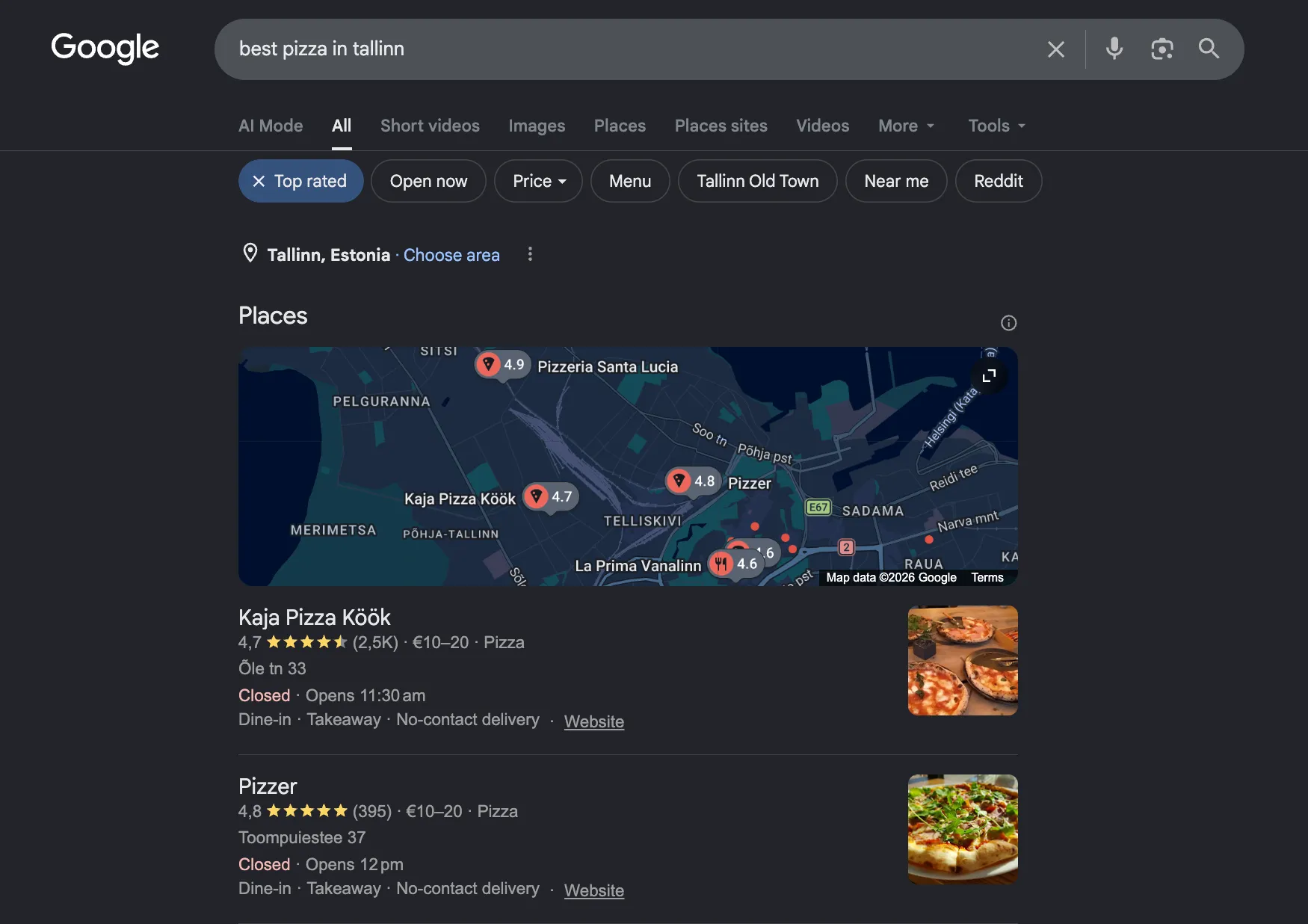
“best pizza in tallinn” on Google. The map pack, the ratings, the opening hours, and then more Google surfaces underneath.
You are not being sent anywhere. You are being kept. Google decided a long time ago that every search is a problem to be solved, and that the solution should live on Google.
That decision explains most of the product line. People searching for local businesses were leaking out to other sites, so there is Google Maps, and for finding a restaurant near you it wins ten times out of ten. People searching “how to tie a tie” wanted video, and there is YouTube. Attention spans got shorter and there are Shorts. Each one is a wall around the same garden. Do not leave, please, we have that here too.
AI Mode is the newest wall, and the most effective one.
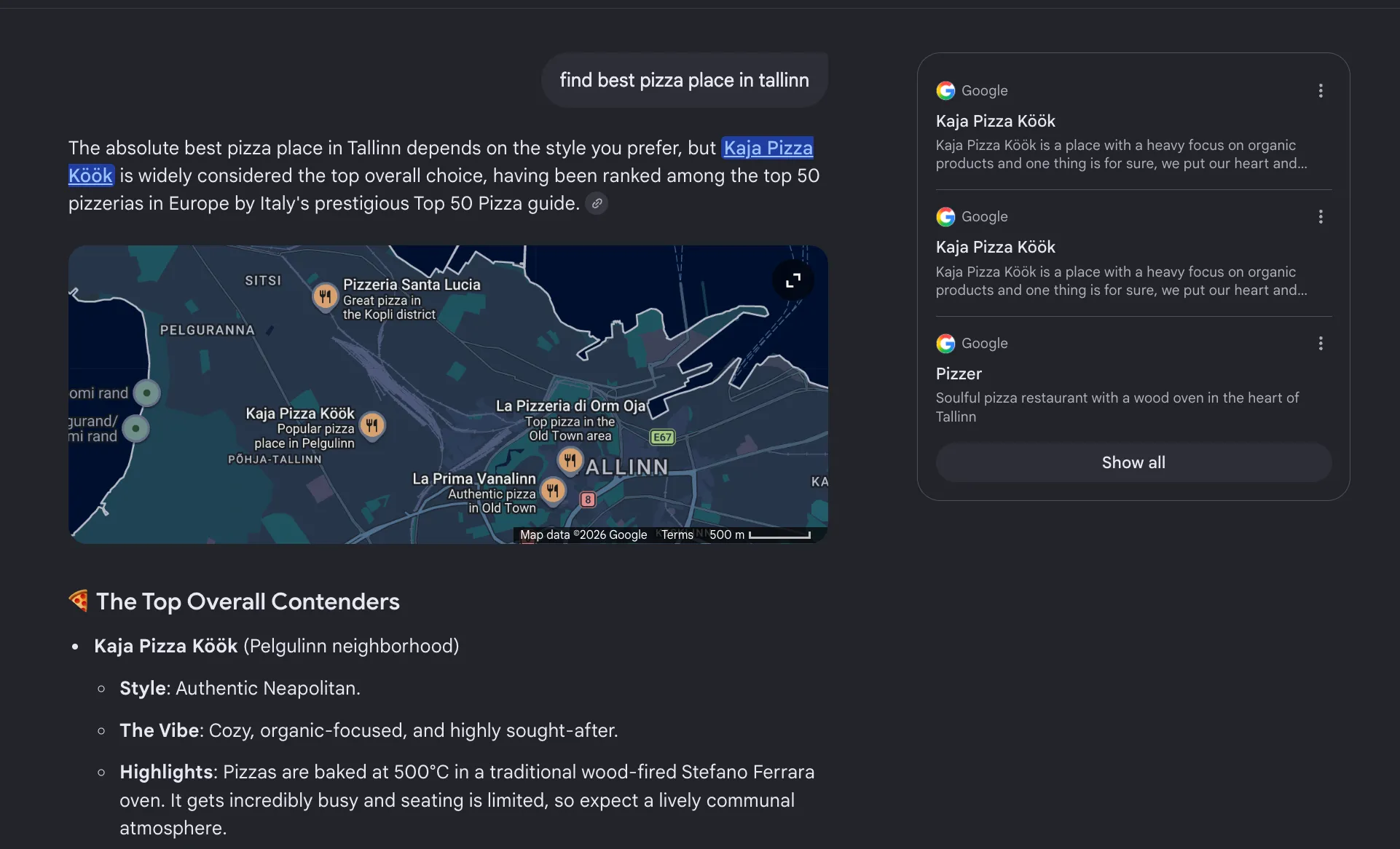
The same question in AI Mode. Every source it read is listed on the right, collapsed behind “Show all”. None of them gets a visit.
Look at that panel for a second. Somebody wrote each of those pages, and their reward is a citation chip that almost nobody clicks.
That is the whole tension. Google cannot exist without websites - no websites, no index, no training data, no ad business. But it also does not want to send you to those websites, because you leaving is revenue walking out of the door. So the strategy settles into extracting everything the site knows and keeping the visit.
The sites that already paid for this
This is not theoretical. It already happened to an entire category of the web.
There used to be a healthy business in weather. Sites optimised hard for “weather in Helsinki”, got enormous traffic, and made real money on ads. In Finland, Foreca is the one I always point at. Then Google wired up weather data and started answering the query in place, and a lot of those sites simply stopped being viable.
Same story with “who is president of India”. Google pulls the answer out of Wikipedia and shows it. You used to land on a government site. Now you do not land anywhere.
Publishers have noticed. Cloudflare now gives site owners tools to fight back.
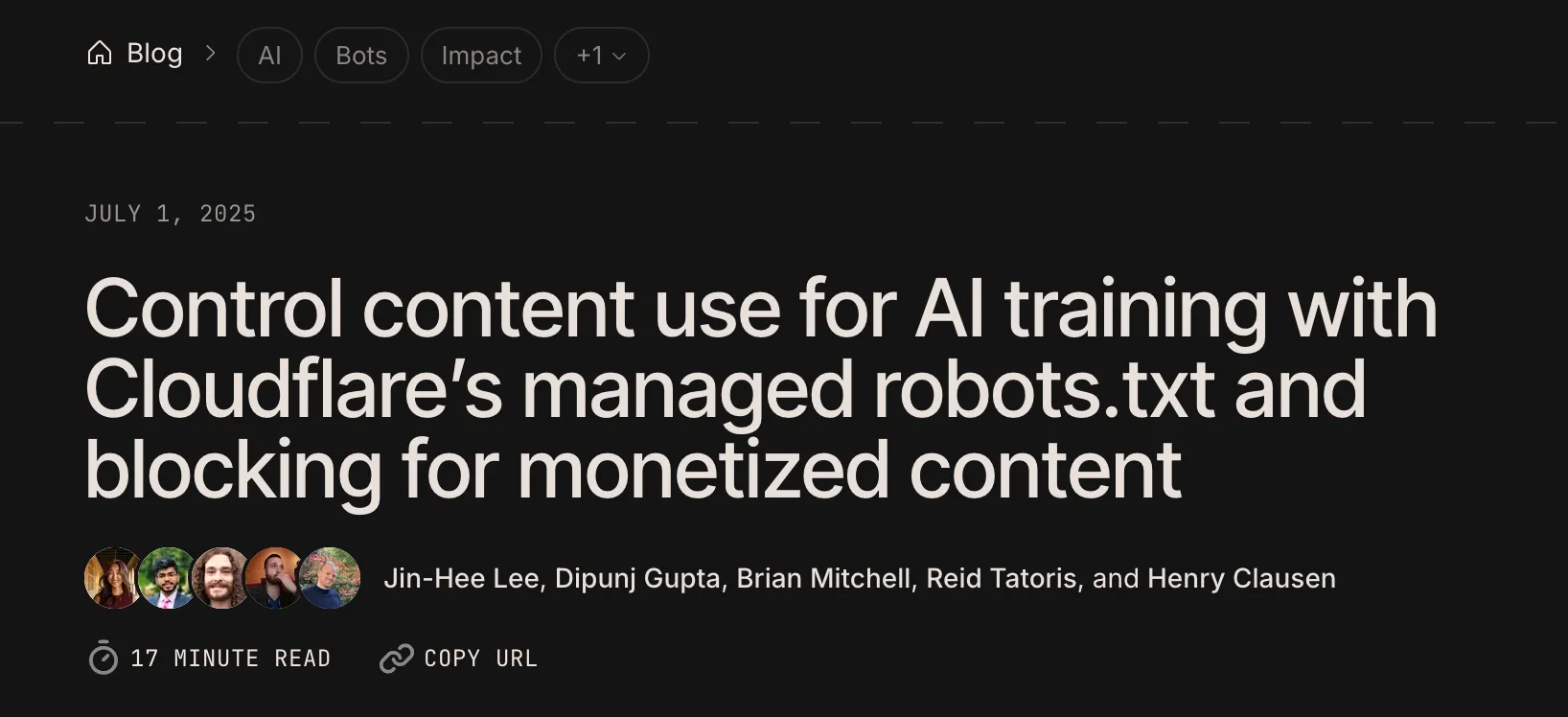
Cloudflare, 1 July 2025. Managed robots.txt, plus the ability to block AI bots specifically on the parts of your site that are monetised through ads.
They are also experimenting with making crawlers pay for access, using HTTP 402 Payment Required, where the site owner sets a per-request price. I want to be accurate about the status: that one is still in private beta, not something you can switch on today.
What your searches know about you
Here is the part that actually moved me, and it has nothing to do with publishers.
Your search history is the most honest document about your life that exists anywhere. Not your posts. Your searches.
You search when you think something is wrong with you. You search for the medication before you tell anyone you are taking it. You search how to leave a marriage before you have said it out loud. You search immigration rules for a country months before you tell your employer. Nobody performs in a search box.
Yes, there is incognito mode. Come on. You do not use it every time, and it does not help on your phone, where you are signed in anyway.
And a search engine is only one input. Combine the queries with the mail, the video history, the IP addresses, the Maps timeline that records where you went by default, and you are not looking at a log. You are looking at a graph of a person.
Then the genuinely strange part: we volunteer the rest. We upload the photos, we write the reviews, we make the videos, we correct the map. I include myself in that.
This is the same move I already made with AI
I wrote in June about why open-source AI has to win, and I am not going to re-run that argument here. The short version: I do not want core infrastructure that someone else can switch off, reprice, or train on.
Search is the same argument pointed at a different product. I have been self-hosting since I ran the school Linux server in seventh grade, and I have a Synology at home running my own alternatives to a stack of Google services. The goal I have been working toward is to de-Google myself, gradually, without losing quality.
That last part is what changed. Self-hosting used to be a hobby with a tax: terminal-only, breaks constantly, worth it because you enjoy suffering. That is no longer true. The alternatives are close to the incumbents now, sometimes better, usually cheap, and they hand you back control.
I am still on Google Workspace for mail. I will move that too. Search was the easy one to move first, because switching your default search engine takes thirty seconds and immediately stops the queries flowing.
What five dollars buys
I landed on Kagi. You get 100 searches free to try it, one time, not monthly, which is enough to know whether you like it.
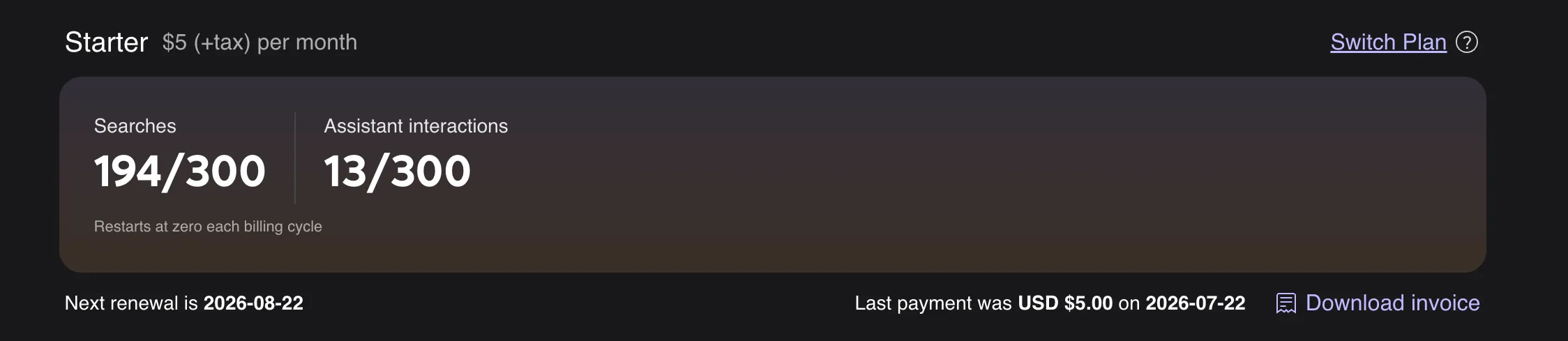
My actual account. Starter, $5 (+tax) per month, 143 of 300 searches used, 10 of 300 assistant interactions. It restarts at zero each billing cycle.
Three hundred searches a month is more than enough for me, and I am a heavy user. That is five dollars. Skip one coffee. The trade you are making the other way is handing over every question you have ever been too embarrassed to ask a human.
I will probably move to the most expensive plan anyway, not because I need the quota but because I want these people to still exist in three years.
The things Google will not build
So here is the actual list: the Kagi features that other search engines do not have, and mostly cannot have.
No ads, therefore no reason to profile you. This is the structural one. Everything below follows from it.
Lenses. Saved filters you build yourself, that you then look at results through.
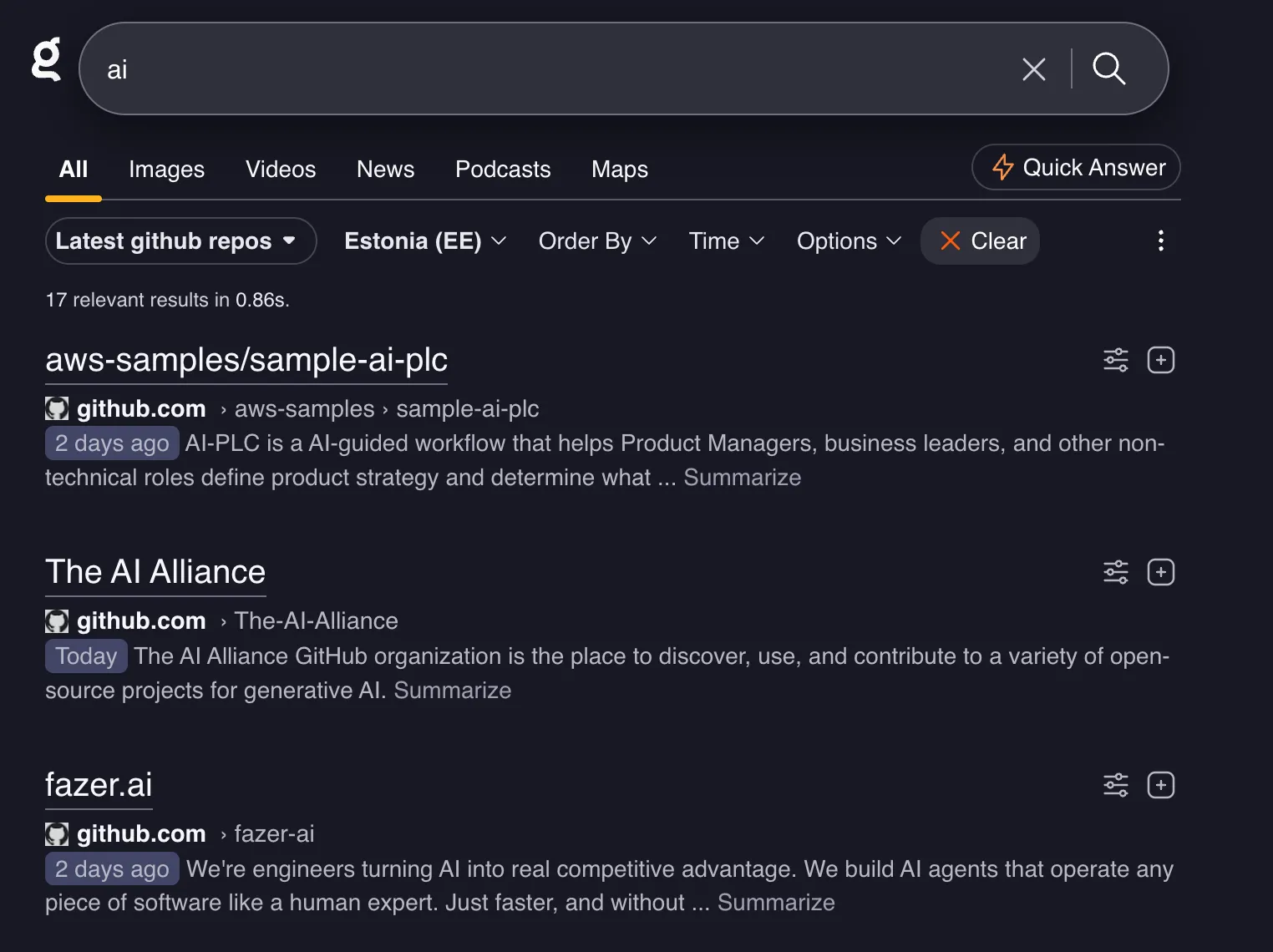
A lens takes about a minute to build: restrict it to github.com, describe what it does, set a custom date range of the last week. Now “ai” returns 20 GitHub repos from the last seven days.
Ranking control over the actual algorithm. You can block a domain from your results permanently, because you have decided it is garbage. You can raise a domain you trust, or pin it. Google will never give you this, because the ranking is the product.
AI that waits to be asked. It is there. It does not jump on you.
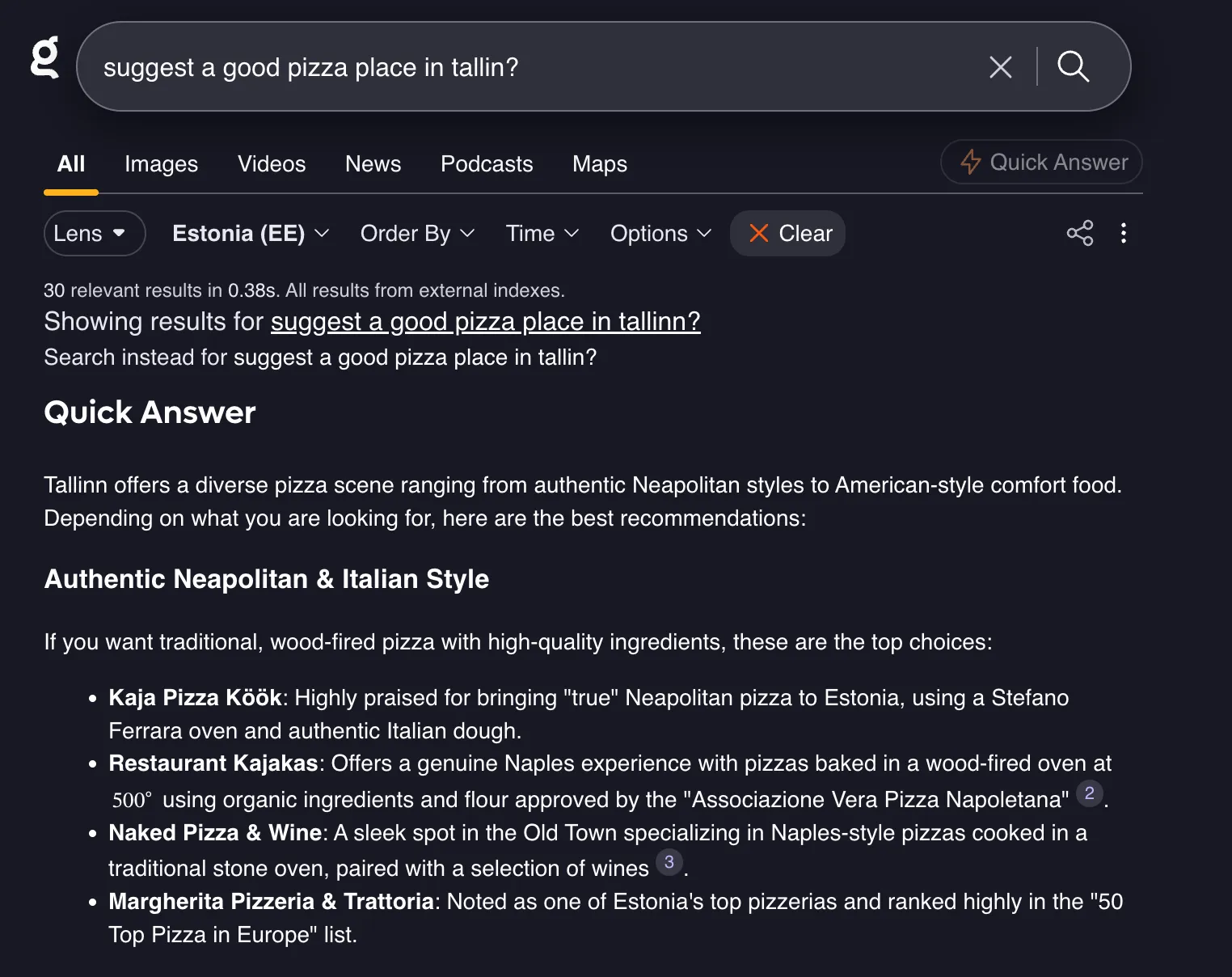
Quick Answer is a button, not a default. And underneath it, the normal links are still the normal links.
That difference matters more than it sounds. News search on Kagi gives you the publishers’ links rather than digesting them into an answer with the sources reduced to footnotes.
You pick the model. The assistant lets you choose who answers.
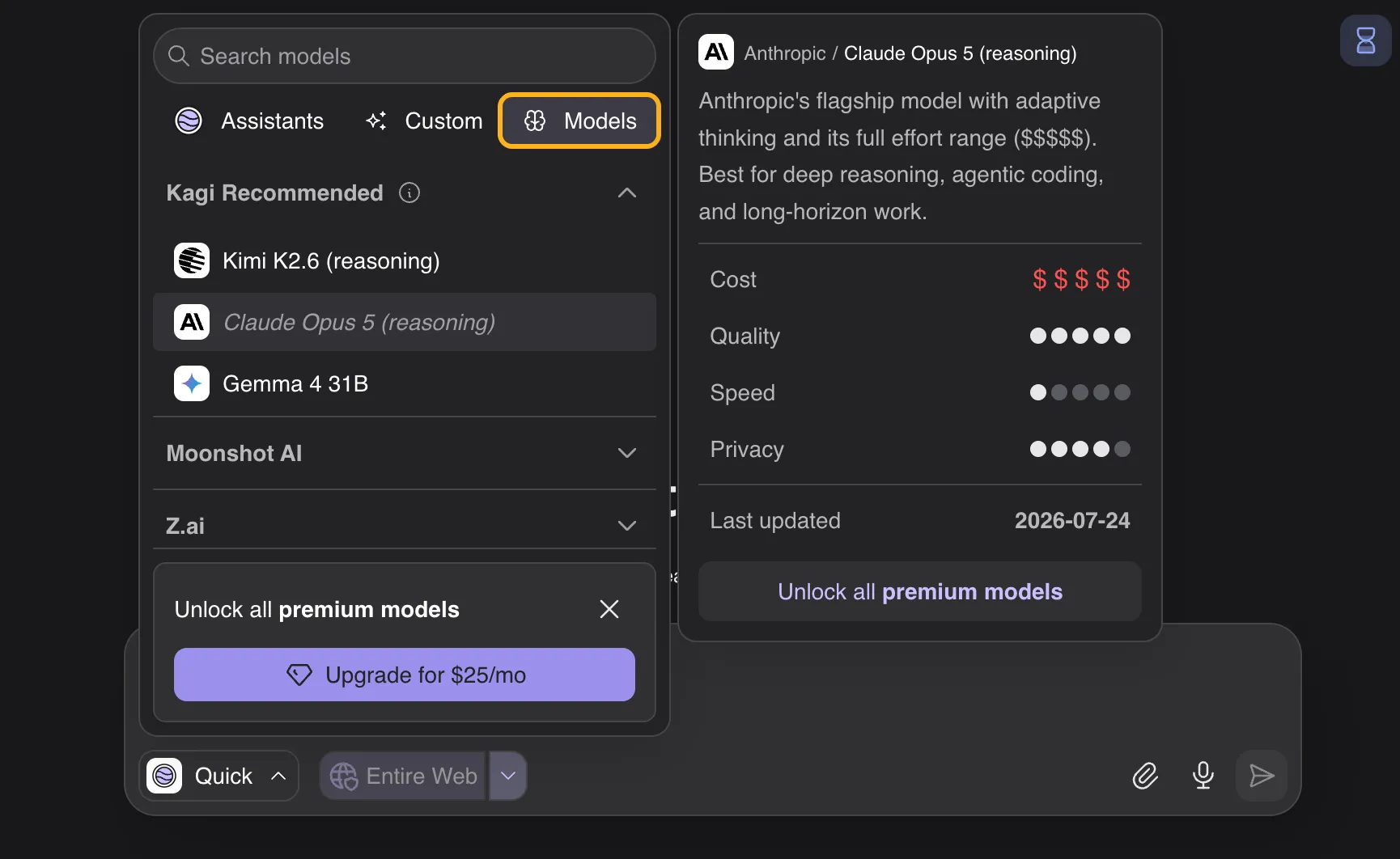
Kimi, Claude Opus 5, Gemma, GLM, with cost, quality, speed and privacy rated per model. The flagship models sit behind the $25/mo tier.
Try to imagine Google offering you a competitor’s flagship model inside Google Search. It is not a product decision they are allowed to make.
Assistant threads are temporary by default and delete after 24 hours. There is also a search API if you want to build on it, at $12 per 1,000 requests, which is reasonable for a small company and obviously not for a million queries.
Where I am not certain
I want to be careful here, because the whole point of this post is not trading one act of faith for another.
Kagi’s privacy claims are Kagi’s claims. Their policy says they do not track which result you click, that AI requests are not saved or tied to your account, and that you are the customer rather than the product. I have read it, it says what I want it to say, and it is still a promise rather than a proof. Verify it yourself rather than taking my word or theirs.
On the AI side their wording is “privacy-respecting services that do not save the data or use it for training, whenever possible”. That last clause is doing real work. I am fine with a third-party model answering my questions as long as it cannot identify me or train on me, but “whenever possible” is a hedge and you should read it as one.
Their maps are built on Mapbox rather than Google, which I like in principle. In practice I have barely used them, and the place data resembles Google’s closely enough that I would not claim independence there.
The cheaper tiers get older models. The genuinely current ones are on the $25 plan.
And Orion, their browser, is excellent on iOS with a real ad blocker built in, and noticeably weaker on macOS. That is my honest experience of it, not a review.
What you are actually buying
The thing I did not expect is how much the switch changed my thinking about paying for software generally.
I used to default to free. Now I run a business, and I understand what free does to the company on the other side of it. If a product I depend on takes no money from me, it has exactly two futures. It shuts down, or it finds another way to make money, and that other way is usually me.
So I pay for Cotypist, which I mentioned in June as well. Not because there is no free alternative. Because paying converts me from traffic into a customer. I have an obligation to pay him, he has an obligation to keep it good, and that is a relationship. Free is not a relationship.
Five dollars a month is not a stand against anything. It is just the honest price of a thing I use fifty times a day, paid to the people who make it, instead of being collected quietly somewhere else.
I do not notice a difference in the results. That is the part that surprised me most.